Why gaps happen
The forex market closes at the end of the week and reopens at the start of the next. While it is closed, news and events can still change how traders value a currency. So when it reopens, the first price can start away from the last price before the close. That is a gap. Closing and opening times depend on your broker and time zone. Price can also jump around holidays or after big news.
One study looked at the difference between the Friday close and the following Monday open in currency markets. Using 8 major and 9 emerging-market currencies, it studied what happened after this difference was large.[2] It reports that, in the past data it studied, after a large gap between Friday's close and Monday's open, prices in many markets tended to move back the other way within that week.[2] This is a result from past data, not a sign of what the next gap will do.
How a stop-loss fills after a gap
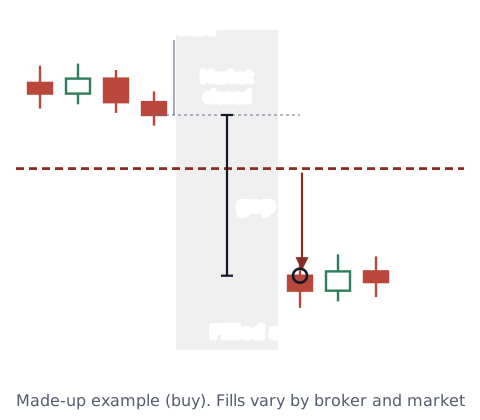
The MT5 help says a stop order "is executed at the price equal to the specified one or worse than that", and that if the market moves the other way, it fills with slippage.[1] A stop-loss is also an order that fills when price reaches it, so if a gap jumps past your stop price, it cannot fill at that price (that a stop-loss works as a stop order and a take-profit as a limit order is our own explanation).
In the chart's example, with a stop at 1.0950 and a first price of 1.0900 after reopening, the fill can be near 1.0900. For 0.1 lots (10,000 units) of EUR/USD in a USD account, 0.0050 × 10,000 = 50 USD more than the planned loss (our example calculation; in an account in another currency, convert at the current rate; actual fills vary by broker, account and market conditions).
Even without a gap, a stop can fill slightly worse than its price in a fast market. This is called slippage. A gap is a case where that difference can be especially large.
On the other hand, the MT5 help says a limit order is executed at "the specified one or better than that".[1] If a gap jumps past your take-profit, it may fill at your price or better (our own explanation; this depends on the broker and account).
Calculations and gaps
Calculations of loss per trade, or of the distance to stop out, assume price moves without jumps. A gap breaks that assumption, and a trade can close after a bigger move than the calculation shows. See also margin and margin level and limit vs stop orders.
Check your own records (you decide)
This article does not decide whether to hold positions while the market is closed. Logging these helps you see how it went for you:
- Whether you held the position while the market was closed
- The stop price you set and the price you actually got
- How you felt when the market reopened
The position size calculator finds a lot size from the amount you are willing to lose, and the daily loss limit calculator sets a limit for the day.
Sources
- MetaQuotes. Performing Deals (MetaTrader 5 Help). https://www.metatrader5.com/en/terminal/help/trading/performing_deals
- Dao, T. M., McGroarty, F., & Urquhart, A. (2016). A calendar effect: weekend overreaction (and subsequent reversal) in spot FX rates. Journal of Multinational Financial Management, 37–38, 158–167. https://doi.org/10.1016/j.mulfin.2016.11.001