What kind of stop moving this is about
This article is about moving your stop further away, so the possible loss gets bigger, for a reason you had not planned. For example:
- Price gets close to your stop, so you move it a little further away
- Price gets close again, so you move it again
- You remove the stop order to “wait and see”
Moving a stop closer because your rules say so (for example, moving it to your entry price after the trade is in profit) is a different thing. What matters is whether that move is written in the rules you made before you entered.
Moving the stop further away changes the loss
For example, with 0.1 lots (the size of your trade) of EUR/USD in a USD account, a 20-pip stop (a pip is a unit of price movement) means a loss of about 20 USD if it is hit. Move it to 40 pips, and the loss becomes about 40 USD. Double the stop distance, and the loss if it is hit roughly doubles. If your account is in another currency, the amounts will differ, but doubling the stop distance still roughly doubles the loss.
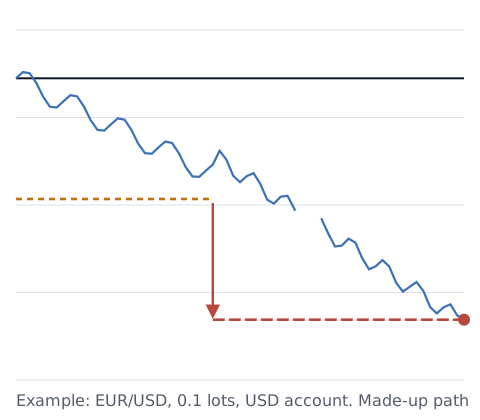
If you keep the same lot size and only move the stop further away, you go past the amount you decided to risk before you entered. If you have a daily loss limit, enter it in the daily trading tracker and enter each loss amount as you log it, to see how much room is left today. You can work out the limit itself with the daily loss limit calculator.
Also, a stop order can be filled at a worse price than the stop, for example when the price moves very fast or when the market reopens at the start of the trading week. If you remove the stop order, you also lose that limit on your loss.
What to check before you move a stop
Go through these four checks in order, so you do not have to decide in a rush.
1. Is this move in my rules?
If the rules you made before you entered include this move, you are following your rules. If not, it is a move you made up on the spot.
2. Further away, or closer?
Moving the stop further away makes the loss bigger if it is hit. Moving it closer does the opposite.
3. How much would I lose at the new stop?
Use the profit and loss calculator to find the loss if the trade closes at the new stop price, and compare it with the amount you planned. If you set your stop as a distance in pips, the stop loss and take profit calculator shows your original stop price again.
4. Write one line about why you want to move it
Write what you are thinking, as it is: “It will turn around soon,” “I hate taking this loss,” and so on. Writing it down first makes it harder to decide on impulse alone.
- If price gets close to my stop and I want to move it further away → I do not move it, and I write the feeling in my journal
- If I move a stop in a way my rules do not include → no new trades for the rest of the day
- If I move a stop closer → only under the conditions I set before entering
Choose rules that fit your own strategy.
Count how often you move your stop
Numbers are easier to notice than feelings. For each trade, write down:
- Did I move my stop further away? (yes / no)
- If yes, how many times?
- The loss I planned, and the loss I actually took
- How I felt when I moved it (rushed, frustrated, hopeful, and so on)
After about a week, you may see your own pattern, such as “I move it more after a losing streak” or “I move it more when I am tired.” The daily trading tracker counts your trades and results with one tap after each trade (the tracker does not count stop moves, so note them separately).
Why we want to move it (research, briefly)
Moving a stop as price gets close is not always a sign of weak willpower. Research describes tendencies that many people share.
- Prospect theory suggests that people tend to feel a loss more strongly than a gain of the same size, and that when they are already losing, they may be more willing to take risks to avoid taking the loss.[1]
- The tendency to sell winners early and hold on to losers is called the “disposition effect.”[2]
- In 10,000 individual accounts at a US brokerage (stocks, 1987–93), a stock trading above its purchase price (a paper gain) was sold at about 1.5 times the rate of one trading below it (a paper loss).[3]
- A study of retail forex trading (4,226 traders in 126 countries, as the paper counts them) found that traders were more likely to take profits early and hold on to losses when trading their own country’s currency.[4]
- In a lab experiment, a rule that sold automatically at the end of each period greatly reduced this tendency.[5]
These studies looked at when people sold, not at moving stop orders, and they cover different countries, products and years. Still, many of us may be tempted to change a decision we made earlier when we are losing. That is why it helps to decide before you enter, and to have a few checks to go through before you move a stop.
If losses are hard for you, or you find it hard to stop even when you want to, you do not have to deal with it alone. Many countries and regions have support services for money worries or compulsive behavior.
Sources
- Kahneman, D., & Tversky, A. (1979). Prospect Theory: An Analysis of Decision under Risk. Econometrica, 47(2), 263–291. https://doi.org/10.2307/1914185
- Shefrin, H., & Statman, M. (1985). The Disposition to Sell Winners Too Early and Ride Losers Too Long: Theory and Evidence. The Journal of Finance, 40(3), 777–790. https://doi.org/10.1111/j.1540-6261.1985.tb05002.x
- Odean, T. (1998). Are Investors Reluctant to Realize Their Losses? The Journal of Finance, 53(5), 1775–1798. https://doi.org/10.1111/0022-1082.00072
- Han, G., & Preda, A. (2025). Does home bias amplify the disposition effect? Evidence from retail forex trading. Finance Research Letters, 86, 108263. https://doi.org/10.1016/j.frl.2025.108263
- Weber, M., & Camerer, C. F. (1998). The disposition effect in securities trading: an experimental analysis. Journal of Economic Behavior & Organization, 33(2), 167–184. https://doi.org/10.1016/S0167-2681(97)00089-9