When can you trade forex?
Currencies are not traded on one exchange but between banks and other firms around the world. The Reserve Bank of Australia describes foreign exchange markets as "trading in a continuous 24-hour cycle".[3]
For individuals trading through a broker, though, trading is possible almost 24 hours a day on weekdays. At the weekend, trading stops and prices on your chart stop moving. As a rough guide to when the week starts and ends, the Australian Foreign Exchange Committee, run by the Reserve Bank of Australia, says normal trading "commences from 5.00 am (Sydney time) on Monday and closes at 5.00 pm (New York time) on Friday".[1] What day and time that is on your clock depends on where you live and on daylight saving time, and your broker's hours may differ.
Some rough conversions of that week (our own calculation; check your broker's hours):
- London: from about 6 to 8 pm Sunday to about 10 pm Friday (9 pm for a few weeks a year, when the UK and the US change their clocks on different dates; see daylight saving and forex hours for the 2026 dates).
- Sydney: from 5 am Monday to about 7 to 9 am Saturday, depending on daylight saving in each city. Brisbane (Queensland) does not use daylight saving,[6] so it is one hour behind Sydney during the Sydney summer. Other Australian cities depend on their state or territory.
Some brokers also stop taking orders for a short maintenance time each day. In Japan, for example, the Financial Futures Association of Japan notes that brokers carry out maintenance at a set time each day, do not accept orders during it, and that this time differs from broker to broker (in Japanese).[4]
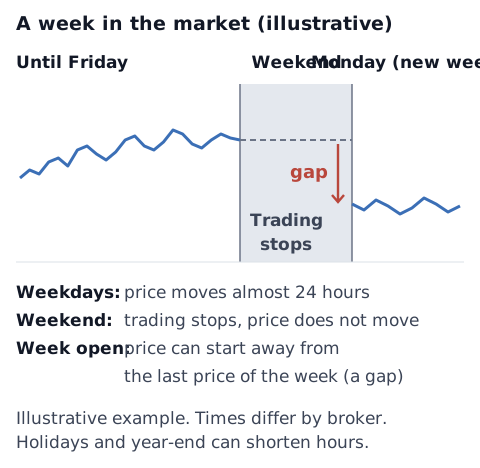
What can happen when you hold over the weekend
- Price can gap at the open: news and events can change the picture while the market is closed, so the first price of the new week can start away from the last price of the previous week. If a gap jumps past your stop-loss, the stop can be filled at a worse price than where you set it. See price gaps and your stop-loss for charts.
- You cannot close straight away while it is closed: while trading is stopped, you cannot buy or sell on the spot, even if news comes out.
- Swap differs by weekday: the amount can depend on the day of the week you roll over. For example, the MT5 help shows a setting where the swap ratio is 1 on every weekday except Wednesday, when it is 3, so rolling over from Wednesday to Thursday counts three days.[5] Which day gets how much differs by broker, so check your broker's information. How swap works is covered in forex swap and rollover.
Holidays, the year-end and Christmas
Public holidays differ by country and region. When one region is on holiday, trading can go on elsewhere. So around holidays and the year-end, trading hours can be shorter than usual, hours that are normally open can be closed, and thin trading can last longer. The exact days and hours differ by broker, account and symbol. Check your broker's announcements each year. For the 2026-27 holiday dates and their times in ET, London and Tokyo, see forex market hours over Christmas and New Year 2026-27.
Some examples of public holidays, to show how they differ by place:
- UK (England and Wales): bank holidays include Good Friday, Christmas Day and Boxing Day. In 2026, Good Friday is April 3, Christmas Day is Friday, December 25, and Boxing Day falls on a Saturday, so the bank holiday moves to Monday, December 28.[7]
- Australia: in New South Wales, for example, Anzac Day is Saturday, April 25, 2026 and Boxing Day is Saturday, December 26, 2026, so Monday, April 27 and Monday, December 28 are additional public holidays.[8] Holidays and substitute days differ between states.
- United States: federal holidays in 2026 include Independence Day (observed on Friday, July 3) and Thanksgiving Day (Thursday, November 26).[9]
When a holiday falls on a weekend, a weekday may become a substitute holiday instead. For trading hours, what matters is the holidays that fall on weekdays. Holidays in large markets such as the US and the UK can also affect how much is traded, even if your own country is not on holiday. Whether your broker closes, shortens its hours or trades as usual on days like these depends on the broker, so check its announcements.
Thin trading and the spread
When little is being traded, the spread (the gap between the buy and sell prices) can widen. In Japan, for example, the Financial Futures Association of Japan explains that when liquidity in the interbank market falls, the spreads that brokers are quoted can widen, and says to take particular care on major countries' holidays, such as Christmas, and in the early-morning hours, when less is traded (in Japanese).[2]
The Reserve Bank of Australia reported that, according to market participants, liquidity conditions in the Australian dollar market in March 2020, a period of market stress, "were especially poor early in the Australian trading day but improved once Japanese markets opened".[3] That was a period of stress, and it is not always like that. When spreads widen is covered in what is the spread.
What "early morning" or "the start of the day" means on your clock depends on where you live. To see the main sessions in your own time zone, use the forex market hours tool.
How to check your broker's trading hours
- The symbol specification in MT5: according to the MT5 help, choosing "Specification" from the right-click menu of the Market Watch window shows the symbol's trading conditions. "The lower part shows information about quoting and trading sessions of the symbol. Sessions are specified for every day of the week."[5]
- Your broker's announcements: check your broker's announcements page for trading hours around holidays, the year-end and Christmas, and for the daily maintenance time.[4]
- Converting the time: MT4/MT5 charts usually show your broker's server time. To convert it to your local time, use the server time converter. Check your broker's documentation for which time zone the specification times are given in.
MT4, mobile apps and other platforms may name or place this differently, or not show it.
Check your own records (you decide)
This article does not decide whether you hold positions over weekends or holidays. If you keep records, you can see later how it went for you.
- Whether the position was held over a weekend or holiday
- The gap between the first price of the new week and the last price of the previous week
- The swap charged or paid in that time (the Swap column in your history)
- How you felt while holding, and when the market reopened
To total up swap over a number of nights, use the swap calculator. How big the forex market is, and where it trades, is covered in how big is the forex market.
Sources
- Australian Foreign Exchange Committee. Q&A (Question 3). https://afxc.rba.gov.au/qa/
- The Financial Futures Association of Japan. 学ぼう!FX #7 スプレッド、手数料について (Learn FX #7: About spreads and fees) [in Japanese]. https://www.ffaj.or.jp/learning/?p=23
- Reserve Bank of Australia. (2020). Box B: Recent Developments in Foreign Exchange Markets. Statement on Monetary Policy – May 2020. https://www.rba.gov.au/publications/smp/2020/may/box-b-recent-developments-in-foreign-exchange-markets.html
- The Financial Futures Association of Japan. 学ぼう!FX #6 取引時間について (Learn FX #6: About trading hours) [in Japanese]. https://www.ffaj.or.jp/learning/?p=21
- MetaQuotes. Market Watch (MetaTrader 5 Help). https://www.metatrader5.com/en/terminal/help/trading/market_watch
- Reserve Bank of Australia. Daylight Saving. https://www.rba.gov.au/schedules-events/daylight-saving.html
- GOV.UK. UK bank holidays. https://www.gov.uk/bank-holidays
- NSW Government. NSW public holidays. https://www.nsw.gov.au/about-nsw/public-holidays
- U.S. Office of Personnel Management. Federal Holidays. https://www.opm.gov/policy-data-oversight/pay-leave/federal-holidays/