Where swap comes from
When forex is offered as a CFD (a contract where only the price difference is settled), the cost or credit for keeping a position open overnight is usually called overnight funding or overnight financing. In a 2025 review of firms offering CFDs to retail clients, the UK Financial Conduct Authority (FCA) noted that whether a client pays or receives overnight funding depends on the product and on whether the position is long (a buy) or short (a sell).[1]
Behind it is the gap between two interest rates. Every currency has an interest rate. Holding a currency pair in forex means you have bought one currency and sold the other, so you receive interest on the currency you bought and pay interest on the one you sold (our own explanation; in Japan, for example, the Financial Futures Association of Japan explains it the same way, in Japanese).[2]
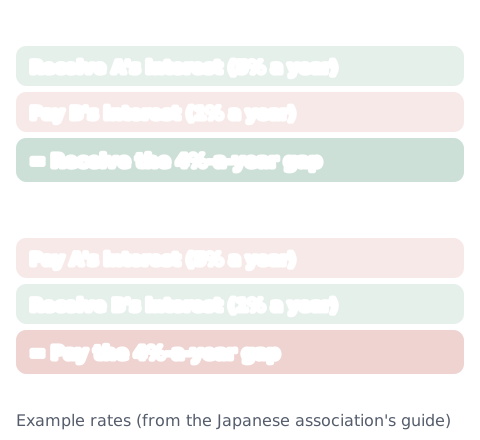
In the diagram's example, one currency is at 5% and the other at 1%: holding it as a buy, you receive an amount equal to the 4% gap as swap.[2] If you hold the same pair as a sell, it is reversed, and you pay the gap.
When it is added
What happens behind the scenes depends on what your broker offers.
- Forex offered as a CFD: no currency is ever delivered; the cost or credit is the overnight funding described above. The FCA's 2025 review called overnight funding "a substantial ongoing cost for clients" and found large differences between firms in what they charged.[1]
- Spot forex with a settlement date: in the US, the National Futures Association explained in 2004 that retail forex trades have a settlement date when the currencies are due to be delivered. To keep a position open without receiving the currency, it is rolled over to the next settlement date, and most dealers charged a rollover fee based on the interest rate gap.[4]
Either way, in MT5 and similar platforms it usually shows up as swap being added or taken each time the position passes the broker's daily cut-off time (our own explanation).
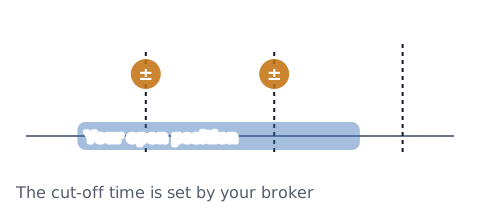
- The amount can differ depending on the day of the week the rollover happens.[5] For example, the MT5 help shows a setting where swap is tripled only when a position is rolled over from Wednesday to Thursday.[5] Which day gets how many days of swap differs by broker, so check your broker's information.
- In MT5, the swap rates for buy and sell positions (swap long and swap short) are set separately.[5] The amount your broker shows is not always the plain interest rate gap. If it includes the broker's costs, a pair with a small rate gap can have a payment on both the buy and the sell side (this is our own explanation). The FCA review found that some firms charged retail clients on short positions where other firms would have paid a credit on the same position.[1] Check both amounts.
The amount changes, and can turn into a payment
Because swap follows the interest rate gap, it changes when either rate changes. In Japan, for example, the Financial Services Agency warns that swap changes daily with short-term interest rates, so you may not receive the swap you expected, and receiving can turn into paying (in Japanese).[3]
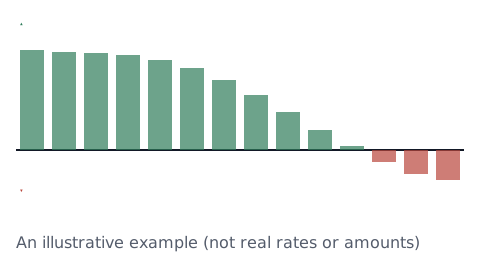
If either currency's interest rate moves, the gap moves too, and so does the daily amount.[2] Today's amount will not necessarily last. You may hear that you can "just hold and get paid every day", but that only holds while you hold the receiving side and the rate gap stays that way. The amount changes, it can turn into a payment, and you can lose on the price move in the meantime.
Look at it together with price moves
Even if you are receiving swap, if the price moves against you in the meantime, your total can be a loss.
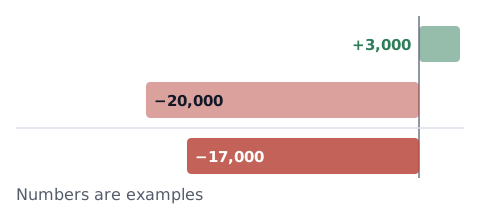
The US Commodity Futures Trading Commission (CFTC) notes that most OTC forex customers lose money when all credits, financing charges, fees and other expenses are factored in.[6] Look at the total, not only the swap or only the price move. The article on counting a month of trading costs shows how to add it all up.
Things to check yourself
- The swap on your pairs: how much for a buy and for a sell; check your broker's website or trading platform
- Differences by weekday: which day gets how many days of swap
- Your account type: swap can be handled differently depending on the account type. Some brokers offer swap-free accounts for people who want to avoid paying or receiving interest, for example for religious reasons. There may be other fees instead, and the terms differ from company to company. Check your own broker's terms
- The swap column in your history: how much you actually received and paid
To total up swap over a number of days, use the swap calculator; for profit or loss from a price move, use the profit and loss calculator. What you do is your decision; this article does not make it.
Sources
- Financial Conduct Authority (UK). (November 13, 2025). Multi-firm review of contracts for difference providers' provision of price and value. https://www.fca.org.uk/publications/multi-firm-reviews/contracts-difference-providers-provision-price-and-value
- The Financial Futures Association of Japan. 学ぼう!FX #8 スワップポイントについて (Learn FX #8: About swap points) [in Japanese]. https://www.ffaj.or.jp/learning/?p=25
- Financial Services Agency, Japan. (Updated February 21, 2020). いわゆる外国為替証拠金取引について (About so-called foreign exchange margin trading) [in Japanese]. https://www.fsa.go.jp/ordinary/iwagai/
- National Futures Association (US futures industry self-regulatory organization). (2004). Trading in the Retail Off-Exchange Foreign Currency Market: What Investors Need to Know (PDF p. 5). Copy hosted by Nasdaq: https://www.nasdaqtrader.com/content/phlxwco/forex.pdf
- MetaQuotes. MetaTrader 5 Help: Market Watch (contract specification). https://www.metatrader5.com/en/terminal/help/trading/market_watch
- U.S. Commodity Futures Trading Commission. Customer Advisory: Eight Things You Should Know Before Trading Forex. https://www.cftc.gov/LearnAndProtect/AdvisoriesAndArticles/CustomerAdvisory_MustKnowForex.html