What happens as open losses grow
Say you deposit 100,000 (in your account's currency) and open a trade, and the money needed to keep that position open (the required margin) is 40,000. As your open loss grows, the money left in your account shrinks.
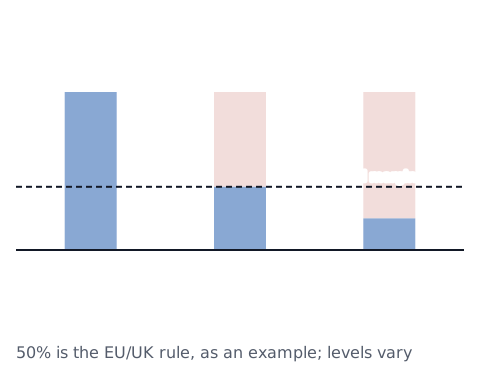
This % is called the margin level (money left ÷ required margin × 100). In the example, when the open loss reaches 80,000 and 20,000 is left, the margin level is 50%. By the time the positions are closed, 80% of the 100,000 deposit is gone.
- When the margin level falls below a set level (the stop out level), the stop out begins. Rules often set this level as a percentage of the required margin, such as the 50% in the EU, UK and Australian rules below.[1][2][4]
- Some accounts send a warning before that level (a margin call).
The lesson on margin and margin level explains the terms and the math. To see how far price can move before your account is stopped out, use the margin level and stop out calculator.
How the rules differ by region
The stop out level, and what happens to losses larger than your deposit, depend on the rules. Here are some published rules. (The EU, UK and Australian rules are for retail clients, which covers most individual traders but not professional or wholesale clients. Japan's rules cover a broker's clients as defined in the association's rules.)
Stop out: close positions when the account's funds plus open profit or loss fall below half of the required margin.[1]
Losses beyond the deposit: the client's liability is limited to the funds in that account.[1]
This was a temporary 2018 decision by the European Securities and Markets Authority, covering CFDs (contracts where only the price difference is settled), which include forex.[1] Between 2019 and 2020, national regulators in EU countries replaced it with their own rules.[8]
Stop out: close positions when funds fall to 50% of the margin needed to keep them open.[2]
Losses beyond the deposit: clients cannot lose more than the funds in their account.[2] (Made permanent in 2019.)
If a firm fails: the Financial Services Compensation Scheme (FSCS) can pay up to £85,000 per person, per firm, when a covered investment firm has gone out of business and cannot return your money. It does not pay for losses from price moves.[9]
Complaints: first complain to the broker. If you are not happy with its answer, or it has not answered within 8 weeks for most complaints, you can take the complaint to the Financial Ombudsman Service (FOS) for free.[10]
Stop out: if the money in the account (net equity) falls below 50% of the total initial margin for the open positions, the broker must close one or more positions as soon as market conditions allow.[4] The aim is to close positions before all or most of the client's money is lost.[3]
Losses beyond the deposit: limited to the funds in the account.[3] (From March 29, 2021.)
Complaints: ASIC says firms covered by its dispute resolution rules must be members of the Australian Financial Complaints Authority (AFCA), and that AFCA can handle complaints that the firm could not resolve internally.[11] Check whether the firm is an AFCA member before you rely on it.
Stop out: each broker sets its own level, above a minimum in the industry association's rules (for example, at least 15% at 25:1 leverage).[5]
Losses beyond the deposit: if a stop out closes positions at a loss larger than the deposit, the client owes the broker the difference, and brokers must explain this in advance.[5]
Countries and regions not listed here have their own rules. Even in one country, the level differs by broker and account type, and the rules that apply can depend on where the broker is registered, which may not be the country you live in. Brokers outside these rules may not offer these protections. To check your own account:
- Look on the broker's website or account information for terms like "stop out level", "margin call" and "negative balance protection"
- Read the sections on stop outs and negative balances in the client agreement (the terms you accepted)
- If you cannot find them, ask the broker's support
When the stop out comes too late
A stop out does not guarantee you are closed at the level. If price jumps, the trade closes at the price after the jump.
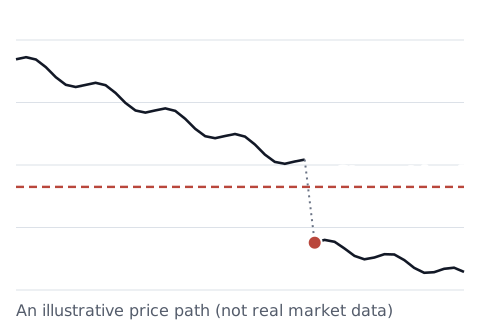
So a stop out does not promise that your loss stays within your deposit. The lesson on price gaps explains why prices jump, for example at the start of a week.
This has happened. The Swiss National Bank had a policy of not letting one euro fall below 1.20 Swiss francs, and on January 15, 2015 it announced it was ending that policy.[6] After the large price move that followed, US forex broker FXCM said its clients had significant losses and negative balances owed to FXCM of about 225 million dollars.[7]
How losses larger than your deposit are handled
When a loss is larger than the money in your account, it is handled in one of two broad ways.
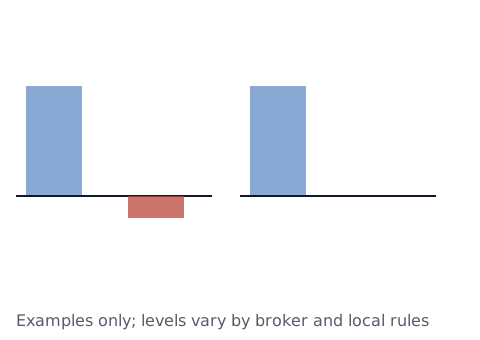
- You pay the shortfall: your balance goes negative and you owe that amount to the broker, as in the Japan box above.[5]
- Negative balance protection: your loss is limited to the money in your account. In the UK and Australia it is required for retail clients. In the European Union it was set by the 2018 decision, which national rules replaced between 2019 and 2020.[1][2][3][8]
Things to check yourself
- Your account's stop out level: at what % positions are closed, and whether there is a warning level
- How losses larger than your deposit are handled: is there negative balance protection, or do you owe any shortfall?
- Your current room: how far price can move against your positions before a stop out (margin level and stop out calculator)
- Times when price is more likely to jump: whether you hold positions over the weekend or around major announcements
A stop out is set by your broker. A stop loss is an order you place yourself. You can work out how much you are willing to lose in a day with the daily loss limit calculator, and your trade size with the position size calculator. What you do is your decision; this article does not make it.
Sources
- European Securities and Markets Authority. (2018). Notice of ESMA's Product Intervention Decisions in relation to contracts for differences and binary options (ESMA35-43-1135; decisions adopted May 22, 2018). https://www.esma.europa.eu/sites/default/files/library/esma35-43-1135_notice_of_pi_decisions_on_cfds_and_binary_options.pdf
- Financial Conduct Authority. (July 1, 2019). FCA confirms permanent restrictions on the sale of CFDs and CFD-like options to retail consumers. https://www.fca.org.uk/news/press-releases/fca-confirms-permanent-restrictions-sale-cfds-and-cfd-options-retail-consumers
- Australian Securities and Investments Commission. (October 2020). 20-254MR ASIC product intervention order strengthens CFD protections. https://www.asic.gov.au/about-asic/news-centre/find-a-media-release/2020-releases/20-254mr-asic-product-intervention-order-strengthens-cfd-protections
- Australian Securities and Investments Commission. (2020). Explanatory Statement, ASIC Corporations (Product Intervention Order—Contracts for Difference) Instrument 2020/986 (registered October 23, 2020). Federal Register of Legislation. https://legislation.gov.au/F2020L01338/asmade/2020-10-23/es/original/pdf
- The Financial Futures Association of Japan. (Established January 26, 2011; amended June 17, 2020, in force from December 1, 2020). 金融先物取引業務取扱規則第25条の3に関する細則(外国為替証拠金取引に係るロスカット取引関係) (Detailed rules on stop out ("loss cut") transactions in retail forex margin trading) [in Japanese]. https://www.ffaj.or.jp/wp-content/uploads/2019/06/ffaj-gyotori25_3-saisoku-20200617.pdf
- Swiss National Bank. (January 15, 2015). Swiss National Bank discontinues minimum exchange rate and lowers interest rate to –0.75%. https://www.snb.ch/public/asset/en/www-snb-ch/publications/communication/press-releases/2015/pre_20150115/publications0_en/pre_20150115.en.pdf
- FXCM. (2015, January). FXCM Comments on Swiss Franc Movement (statement reprinted by Mondo Visione). https://mondovisione.com/media-and-resources/news/fxcm-comments-on-swiss-franc-movement-2015116/
- European Securities and Markets Authority (ESMA). Product intervention. https://www.esma.europa.eu/investor-corner/product-intervention
- Financial Services Compensation Scheme (FSCS). Investments. https://www.fscs.org.uk/what-we-cover/investments/
- Financial Ombudsman Service. How to complain. https://www.financial-ombudsman.org.uk/consumers/how-to-complain
- Australian Securities and Investments Commission. Dispute resolution. https://asic.gov.au/regulatory-resources/financial-services/dispute-resolution/