What the house money effect is
A 1990 paper used the name "house money effect" for the finding that people become more willing to take risks after a prior gain.[1] "House money" means money won from the casino (the house).
The paper explains that a loss at that point is felt as a smaller gain, as if losing part of your winnings does not hurt as much as losing your own money.[1]
A real-money experiment
The experiment was run with real money in an introductory economics class at a US university.[1]
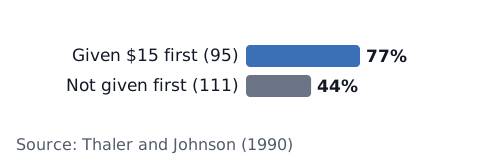
- Asked after a gain: "You have won 15 dollars. Will you now take a 50-50 gamble to win or lose 4.50 dollars?" Of 95 people, 77% took it[1]
- Asked as one choice: "A sure 15 dollars, or a 50-50 chance of 19.50 or 10.50 dollars?" Of 111 people, 44% chose the risky option[1]
In the same paper, earlier experiments with hypothetical questions gave similar results: 70–82% chose the risk after a gain, against 43–44% when it was one choice.[1] These were experiments with students, not a study of trading.
Studies of real trading records
- Taiwan stock index options market: one study found that traders who made gains in the morning took above-average risks in the afternoon.[2] The study also notes that, in theory, earlier results can lead to either more or less risk taking, depending on the conditions.[2]
- A futures exchange in Chicago, US: on the other hand, another study found that proprietary traders took above-average afternoon risk to recover from morning losses.[3]
In other words, earlier results in the day can affect the next decision both after wins and after losses. For the losing side, see how to stop revenge trading.
Where it can show up in trading
For example (these are our own examples):
- On a day with a big win, you raise your lot size because "I'm already up today"
- You treat your winnings as separate "profit" money and take setups you would usually skip
- Because you are up for the month, you loosen the loss limit you had set
Even after a win, the money you can lose on the next trade is your own. This article does not decide whether sizing up after a win is right or wrong. The aim is to check in your own records whether you did what you had planned.
Check your own records (you decide)
- Lot size after wins: after a big win or a winning streak, is your lot size bigger than usual?
- Results after wins: look at the trades where you sized up after a win separately from your other trades
- How you keep limits: on days when you are up, do you change the loss limit or trade-count limit you had set?
The position size calculator shows lot size, and the daily loss limit calculator shows a daily limit. The trading stats calculator shows the numbers in your records. This article does not decide how you should trade.
Sources
- Thaler, R. H., & Johnson, E. J. (1990). Gambling with the House Money and Trying to Break Even: The Effects of Prior Outcomes on Risky Choice. Management Science, 36(6), 643–660. https://doi.org/10.1287/mnsc.36.6.643
- Liu, Y.-J., Tsai, C.-L., Wang, M.-C., & Zhu, N. (2010). Prior Consequences and Subsequent Risk Taking: New Field Evidence from the Taiwan Futures Exchange. Management Science, 56(4), 606–620. https://doi.org/10.1287/mnsc.1090.1131
- Coval, J. D., & Shumway, T. (2005). Do Behavioral Biases Affect Prices? The Journal of Finance, 60(1), 1–34. https://doi.org/10.1111/j.1540-6261.2005.00723.x