What overconfidence is
Overconfidence means believing your information or judgment is more accurate than it really is. With overconfidence, more situations feel like "I know where this is going", which is thought to lead to more trades.[1]
A study of trading activity and returns
One study looked at the stock trading of 66,465 households with accounts at a large US discount broker from 1991 to 1996.[1]
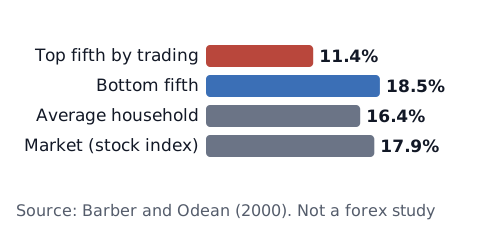
- Households that traded most: dividing households into fifths by how much they traded, the top fifth earned 11.4% a year after costs, while the market returned 17.9%
- The average household: 16.4% a year after costs, replacing about 75% of the stocks it held each year
- Top fifth versus bottom fifth: the top fifth (households replacing more than 8.8% of their stocks a month) earned 11.4% a year after costs, and the bottom fifth earned 18.5%. Before costs, all five groups earned 18.5% to 18.7%, very little difference
In other words, the lower returns of the most active households came mainly from the costs paid on each trade. The researchers say the results can be explained by the idea that overconfidence leads to excessive trading and lower returns.[1]
These are results for US stock accounts in the 1990s, and they may not carry over to forex or to today's markets. Overconfidence is also one explanation of the results; it does not mean that trading less will make you more profitable.
Forex, trade count and costs
In forex too, every trade costs a spread and sometimes a commission (see what is the spread). Even with the same results per trade, more trades mean higher total costs. To add up a month of costs, see counting your trading costs.
Check your own records (you decide)
This article does not decide how often you should trade. Whether overconfidence affects your own trade count is something you can check in your records:
- Trade count after wins: split your days into those with 2 or more wins in a row and the rest, and compare the average number of trades per day
- How you felt: the results of trades taken when you felt "I'm reading it well" or "things are going my way today"
- Count and costs: your trades per day or week, and the total spread and commission
The daily trading tracker counts trades and wins and losses as you go. The trading stats calculator turns a profit and loss list into win rate and averages. For counting trades, see also overtrading.
Sources
- Barber, B. M., & Odean, T. (2000). Trading Is Hazardous to Your Wealth: The Common Stock Investment Performance of Individual Investors. The Journal of Finance, 55(2), 773–806. https://doi.org/10.1111/0022-1082.00226