Bid, ask and spread
In MT5's Market Watch, each currency pair shows a bid and an ask, and the spread column shows the difference.[1] You buy at the higher price (the ask) and sell at the lower price (the bid).
For example, trading 0.1 lots (10,000 units) of EUR/USD in a USD account with a 1.5-pip spread (a pip is a unit of price movement) costs about 1.5 USD per trade (our own calculation). Lot sizes differ by broker; here 0.1 lots = 10,000 units. In an account in another currency, convert at the current rate. To add up a month of costs, see counting your trading costs.
The chart is drawn from the bid
For MT5, the help says chart bars are normally built from bid prices, and that the ask is always used to open buy positions and to close sell positions. You can also turn on an ask price line in the chart settings.[2] Other platforms may differ; check their help pages.
This means the stop-loss or take-profit on a sell position is triggered when the ask reaches it.[5] The chart (bid) may never touch your stop, while the ask did. The wider the spread, the bigger this gap.
Say you sell EUR/USD with a stop at 1.0850. The highest point on the chart (bid) is 1.0849, so the stop looks untouched. But if the spread is 2 pips at that moment, the ask is at 1.0851, which is past your 1.0850 stop. So the stop is hit.
When spreads widen
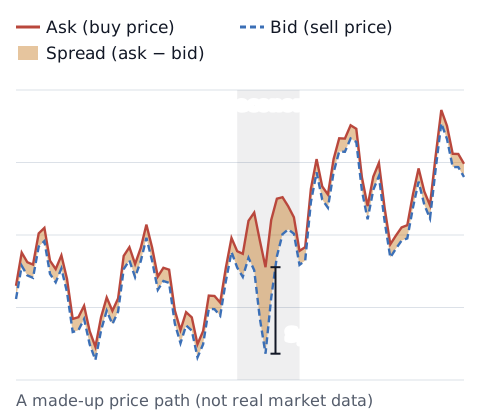
The spread is not always the same.
- Just before major releases: a study of 2012 data from one currency trading platform (EBS) for EUR/USD, EUR/JPY and USD/JPY reported that around scheduled announcements, the spread on average kept widening in the tens of seconds before the burst of activity around the release and narrowed sharply right after it.[3] The study's main aim was a method for finding sudden bursts of activity, and the spread was one part of it. It is also data from a market between banks, not retail broker prices.
- In market turmoil (sudden, disorderly moves): Australia's central bank reported that in the turmoil of March 2020, currency spreads widened sharply and the amount that could be traded (market depth) fell. For the Australian dollar, conditions were especially poor early in the Australian trading day and improved once Japanese markets opened.[4] This describes a period of turmoil, not normal days.
The “releases” here are mostly economic data releases: figures on the economy, jobs, prices and so on that government agencies publish at set dates and times. For example, the release dates and times for the US jobs report (the Employment Situation) are published in advance on a schedule.[6] Many people forecast these figures beforehand, and those expectations are thought to be already reflected in prices. So prices are thought to react mainly to the part of a figure that differs from expectations (a study of the Australian dollar noted that currency markets tend to react to new information very quickly).[7] Which way the price will move, and how far, cannot be known in advance.
How much spreads widen differs by broker, account and time. To see what happens in your own account, check the spread column in MT5's Market Watch at different times of day.
Check your own records (you decide)
This article does not decide when to trade or which account to use. To see how the spread affects you, log these so you can look back later:
- The spread when you entered (the Market Watch number)
- The gap between the price you expected and the price you got
- When you entered, such as around a release
The break-even win rate calculator shows how costs like the spread change the win rate you need, and the position size calculator shows amounts per lot size.
Sources
- MetaQuotes. Market Watch (MetaTrader 5 Help). https://www.metatrader5.com/en/terminal/help/trading/market_watch
- MetaQuotes. Chart Settings (MetaTrader 5 Help). https://www.metatrader5.com/en/terminal/help/charts_advanced/charts_settings
- Rambaldi, M., Filimonov, V., & Lillo, F. (2018). Detection of intensity bursts using Hawkes processes: An application to high-frequency financial data. Physical Review E, 97, 032318. https://arxiv.org/abs/1610.05383
- Reserve Bank of Australia. (2020). Box B: Recent Developments in Foreign Exchange Markets. Statement on Monetary Policy – May 2020. https://www.rba.gov.au/publications/smp/2020/may/box-b-recent-developments-in-foreign-exchange-markets.html
- MetaQuotes. General Concepts (MetaTrader 5 Help). https://www.metatrader5.com/en/terminal/help/trading/general_concept
- U.S. Bureau of Labor Statistics. Schedule of Releases for the Employment Situation. https://www.bls.gov/schedule/news_release/empsit.htm
- Clifton, K., & Plumb, M. (2008). Economic Data Releases and the Australian Dollar. Reserve Bank of Australia Bulletin, April 2008. https://www.rba.gov.au/publications/bulletin/2008/apr/1.html