What leverage is
The UK Financial Conduct Authority (FCA) describes leverage as gaining exposure to an asset by paying only a small proportion of its value.[1]
For example, a trade worth 100,000 US dollars with 4,000 US dollars of margin is 100,000 ÷ 4,000 = 25 times (our own example). Your profit or loss comes from the price move on the full 100,000 US dollars, not on the 4,000 US dollars you deposited. So with leverage, the same price move is a bigger share of your account than it would be without it.
Leverage is written either way around: 1:30 and 30:1 mean the same thing (30 times). This article writes it as 1:30, as many trading platforms do.
In Japan, for example, the Financial Futures Association of Japan describes leverage in the same way, as how many times the margin the trade amount is,[5] and the Financial Services Agency describes forex as a very high-risk product where losses can exceed your margin[6] (both in Japanese).
The formula for required margin
The official MT5 help gives the required margin for forex as:[2]
Required margin = Volume in lots × Contract size ÷ Leverage
In the help's example, buying 1 lot of EUR/USD with a contract size of 100,000 and leverage of 1:100 needs 1 × 100,000 ÷ 100 = 1,000 euros.[2] The result is in the first currency of the pair (euros here), and if your account is in another currency, it is converted at the current rate.[2]
"Lots × contract size" is the amount of currency you trade (see what is a lot). So the leverage in this formula decides what fraction of the trade size you put up as margin: 4% at 1:25, about 3.33% at 1:30, 0.2% at 1:500. How to read the margin figures on your screen is covered in margin, equity, free margin and margin level.
Maximum leverage vs effective leverage
"Leverage" is used in two senses. This article keeps them apart:
- Maximum leverage: the ratio your broker sets for your account. It is the number in the formula above, and it decides the required margin. For retail accounts, regulators in many countries and regions set a limit on it (see forex leverage limits by country and region).
- Effective leverage: how much money your whole account is actually moving. In this article it is calculated as:
Effective leverage = Total position value ÷ Equity
Equity is what your account is worth now, including floating profit and loss (see unrealized profit and loss). Position value is converted into your account currency. How to count positions when you hold both buys and sells differs by broker and by approach, so the examples here use a single position.
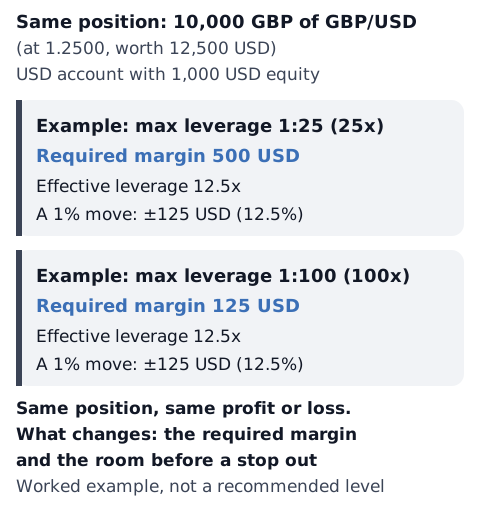
As the diagram shows, for the same position, the profit or loss from a price move is the same whether the maximum is 1:25 or 1:100. What the maximum changes is how much margin you need and how big a position the account lets you open. With a higher maximum, you can open a larger position with less margin, so it is easier for your effective leverage to rise.
Your effective leverage comes down to how many lots you hold for the money in your account. In the same account, changing your lot size changes your effective leverage (see what is a lot).
Higher effective leverage, bigger swings in your account
A 1% price move gives a profit or loss of 1% of the position value. Divide that by your equity and you get the share of your account:
Profit or loss as a share of equity = Price move (%) × Effective leverage
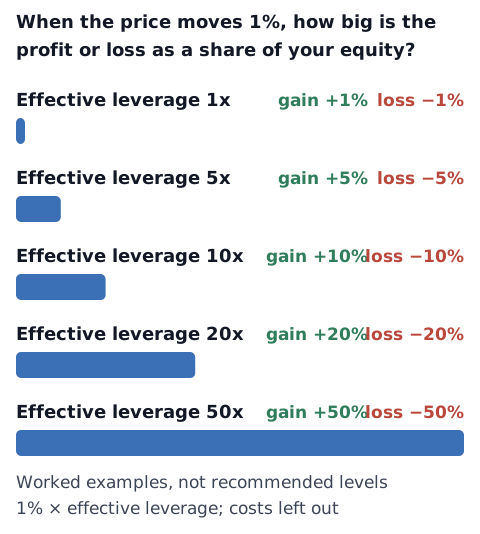
A move in your favor adds that share; a move against you takes it away. It also follows that a move against you of "100% ÷ effective leverage" would take your equity to zero: 5% at 20x, 20% at 5x. By the same formula, a 2% move at 50x, or a 0.2% move at 500x, moves an amount equal to 100% of your account (our own calculation, not a recommendation). In practice a stop out usually happens before that, but if the price gaps, it may not be in time (see what a stop out is).
Worked examples
All three are worked examples for this article, not a suggestion of what leverage or lot size to use. One lot is taken as 100,000 units, and spreads, commission and swaps are left out.
- Example 1: US dollar account, 0.1 lot of GBP/USD: equity is 1,000 US dollars. Holding 0.1 × 100,000 = 10,000 pounds at 1.2500, the position value is 10,000 × 1.2500 = 12,500 US dollars. Effective leverage is 12,500 ÷ 1,000 = 12.5x. A 1% move (0.0125) is 10,000 × 0.0125 = 125 US dollars, or 12.5% of the account. With a maximum leverage of 1:25 (an example), the required margin is 10,000 ÷ 25 = 400 pounds, or 500 US dollars at 1.2500.
- Example 2: British pound account, 0.1 lot of EUR/GBP: equity is 2,000 pounds. Holding 0.1 × 100,000 = 10,000 euros at 0.8500, the position value is 10,000 × 0.8500 = 8,500 pounds. Effective leverage is 8,500 ÷ 2,000 = 4.25x. A 1% move (0.0085) is 10,000 × 0.0085 = 85 pounds, or 4.25% of the account. With a maximum leverage of 1:30 (an example), the required margin is 10,000 ÷ 30 ≈ 333.33 euros, or about 283.33 pounds at 0.8500.
- Example 3: small US dollar account, 0.01 lot of EUR/USD: equity is 100 US dollars. Holding 0.01 × 100,000 = 1,000 euros at 1.0850, the position value is 1,000 × 1.0850 = 1,085 US dollars. Effective leverage is 1,085 ÷ 100 = 10.85x. A 1% move (0.01085) is 1,000 × 0.01085 = 10.85 US dollars, or 10.85% of the account. With a maximum leverage of 1:500 (an example), the required margin is only 1,000 ÷ 500 = 2 euros, or about 2.17 US dollars at 1.0850. The margin is tiny, but a move of about 9.2% against you (100% ÷ 10.85) would equal the whole 100 US dollars. In a "cent" account, the same 100 US dollars would show as a balance of 10,000 (cents), so the amounts on the screen look 100 times bigger (see what is a lot).
Example 1 shows that even when effective leverage (12.5x) is below the maximum (1:25), a 1% move still changes the account by 12.5%. Example 3 shows that a small required margin does not mean a small risk. The idea is the same in an account in US dollars, pounds, euros, Australian dollars, naira or any other currency. The method is covered in how to calculate forex profit.
How it connects to margin level and stop outs
The official MT5 help gives margin level as equity ÷ margin × 100.[3] When the required margin comes from the formula above (position value ÷ maximum leverage), you hold a single position with no pending orders, and margin is calculated at the current rate (MT5's Forex mode), margin level can be rewritten as follows (our own calculation):
Margin level = Maximum leverage ÷ Effective leverage × 100
In example 1, 25 ÷ 12.5 × 100 = 200% (the same as 1,000 ÷ 500 × 100). When a floating loss reduces your equity, effective leverage rises and margin level falls. Adding positions does the same. When margin level falls to the levels your broker sets, you may get a warning (a margin call) or positions may be closed automatically (a stop out; in Japan often called a "loss cut"). See margin call vs stop out for more.
Why the limits differ by country and region
In many countries and regions, regulators limit the maximum leverage for retail accounts. In 2018 the European Securities and Markets Authority (ESMA) introduced temporary limits, reviewed every three months, such as 1:30 for major currency pairs, pointing to evidence at the time that 74–89% of retail accounts typically lost money.[4] How national rules in the EU later replaced them is covered in forex leverage limits by country and region.
When the UK FCA consulted on its own limits in 2018, it said it used the same method as ESMA.[1] The margin was set from past price data, looking at how likely a retail client is to be closed out (at 50% of the starting margin) within one trading day.[1]
These limits are for retail clients. In the UK, the rules apply to firms' dealings with retail clients, so accounts a broker has classed as professional are not covered by them.[7] In Australia, the limits do not apply to professional, sophisticated and other wholesale clients.[8] In Japan, for example, when a firm registered with the Financial Services Agency trades with individuals, margin of at least 4% of the trade amount is required, which works out to 1:25 or less.[6]
How high the limit is, and whether there is a limit at all, also differs by country and region. The limits we could confirm in official regulator sources are listed in forex leverage limits by country and region.
Things to check for yourself
- Your account's maximum leverage: shown in your account details or your broker's trading conditions. It can differ by symbol.
- Your current effective leverage: total position value ÷ equity. It rises when you size up or when a floating loss grows.
- Your stop out level: the margin level at which positions are closed automatically (see what a stop out is).
This article does not decide what leverage to use. That is your decision.
Use the calculators
- Required margin from lot size and leverage: margin calculator
- Lot size from the amount you are willing to lose on one trade: position size calculator
- How many pips are left before the stop out level: margin level and stop out calculator
Sources
- Financial Conduct Authority (FCA). (December 2018). CP18/38: Restricting contract for difference products sold to retail clients and a discussion of other retail derivative products (paragraphs 1.10 and 3.23, footnote 24). https://www.fca.org.uk/publication/consultation/cp18-38.pdf
- MetaQuotes. Margin Calculation: Retail Forex, Futures - MetaTrader 5 Help. https://www.metatrader5.com/en/terminal/help/trading_advanced/margin_forex
- MetaQuotes. Executing Trades - Trading Operations - MetaTrader 5 Help. https://www.metatrader5.com/en/terminal/help/trading/performing_deals
- European Securities and Markets Authority (ESMA). ESMA agrees to prohibit binary options and restrict CFDs to protect retail investors (March 27, 2018). https://www.esma.europa.eu/node/84933
- Financial Futures Association of Japan (FFAJ). #3 証拠金取引とレバレッジ効果について (Margin trading and the effect of leverage) [in Japanese]. https://www.ffaj.or.jp/learning/?p=15
- Financial Services Agency, Japan. いわゆる外国為替証拠金取引について (About so-called foreign exchange margin trading) [in Japanese]. https://www.fsa.go.jp/ordinary/iwagai/
- Financial Conduct Authority (FCA). FCA Handbook, COBS 22.5. https://www.handbook.fca.org.uk/handbook/COBS/22/5.html
- Australian Securities and Investments Commission (ASIC). Explanatory Statement, ASIC Corporations (Product Intervention Order—Contracts for Difference) Instrument 2020/986 (registered October 23, 2020). https://legislation.gov.au/F2020L01338/asmade/2020-10-23/es/original/pdf