Check when the release comes out
For example, the US Bureau of Labor Statistics schedules the Employment Situation report (the US jobs report) for 8:30 a.m. US Eastern Time.[2] That is 12:30 UTC while US daylight saving time is in effect, and 13:30 UTC outside it.
Countries switch clocks on different dates. In 2026, the UK's clocks go back on 25 October,[3] and US daylight saving time ends on 1 November.[4] Around the changes, the time difference between countries can be off from usual for a while. What shifts in the week between, in ET and London time, is laid out in daylight saving and forex hours.
Charts in MT4 and MT5 show your broker's server time, which may differ from your own. To see where a release falls on your chart, use the MT5 server time converter.
Spreads widen
The spread is the gap between the sell price (Bid) and the buy price (Ask). In November 2025, ahead of a delayed set of US employment data, a Japanese forex broker told clients that when markets move suddenly, the spreads of the banks it hedges with (the banks it places offsetting trades with) can widen sharply, so its own spreads can widen sharply too. It also said that if it judges that no prices are being quoted in the interbank market (where banks trade currencies with each other), it will stop streaming prices to clients.[1] A trade opened while the spread is wide starts that much further behind.
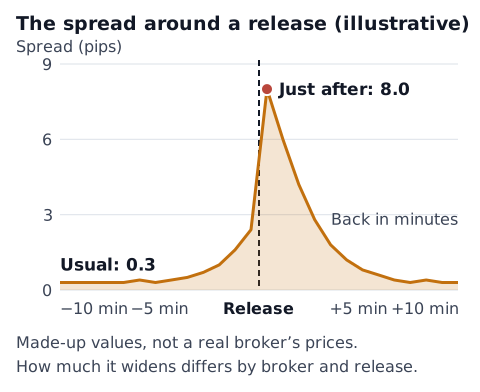
How the spread works, and research on spreads widening just before releases, are covered in what is the spread.
Slippage, and stop-losses filling worse
The same notice also lists slippage between the order price and the fill on market orders, stop orders and similar orders, and the possibility that orders are not filled.[1] FXCM's Australian help page likewise says that volatility can rise sharply after news, and that when price gaps, a stop order can be filled at a worse price than the one you set.[5]
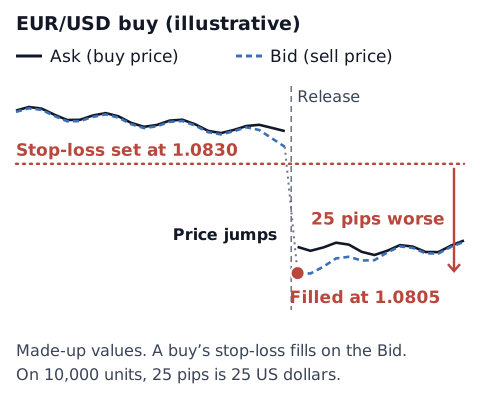
Cost of the slippage = price difference × units traded
0.0025 USD × 10,000 units = 25 USD (made-up example)
A stop-loss becomes an order to close only once price reaches it, so if no trade is possible at that price, it fills at the next price available. How order types relate to slippage is in what is slippage, and how prices jump is in price gaps.
Real events
Neither of these was a scheduled data release, but both are records of what happened when prices jumped suddenly.
- 15 January 2015, Swiss franc: the Swiss National Bank announced it was discontinuing the minimum exchange rate of 1.20 francs per euro and lowering its interest rate to −0.75%.[6] After the move that followed, the US broker FXCM announced that clients' negative balances owed to FXCM came to about 225 million US dollars.[7] Alpari (UK) announced that many of its clients had losses exceeding their account balances, and that the firm had become insolvent (unable to pay its debts).[8]
- 3 January 2019, yen flash event: according to the Reserve Bank of Australia, with no material news, at about 9:36 am Sydney time (AEDT) the yen rose about 3% against the US dollar in about 30 seconds, and the Australian dollar began to fall about 30 seconds after that and was down about 7% against the yen at the low (later, the yen and the Australian dollar retraced about half of their moves against the US dollar). Spreads widened from about 2 pips to 100 to 300 pips. The report notes that liquidity was seasonally low at that time of day and year, and that Japanese banks, many of which act as market-makers, were closed for a public holiday. It adds that automatic closing of Japanese retail investors' positions, once losses passed set levels, may have contributed to the large falls in some higher-yielding currencies.[9]
When an account goes negative
A stop-out (the broker closing your positions automatically when your margin runs too low) can come too late when price jumps. What happens then differs a lot by region.
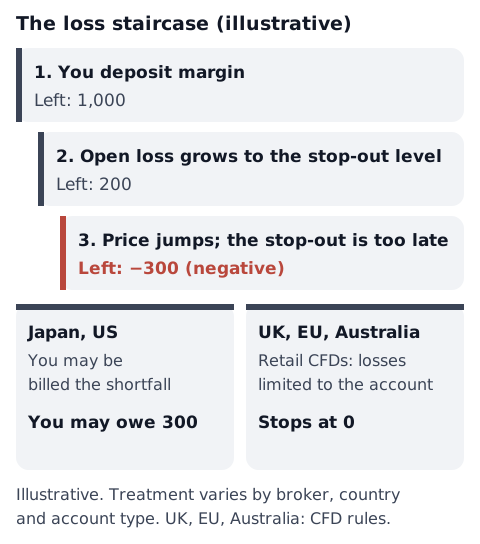
UK, EU and Australia: these are rules for firms regulated there, for retail CFD accounts.
From 1 August 2019, the Financial Conduct Authority (FCA) made permanent its rules that retail clients "cannot lose more than the total funds in their CFD account", and that positions are closed when funds fall to 50% of the required margin.[10]
For retail CFDs, the European Securities and Markets Authority (ESMA) set, initially as temporary measures, from 1 August 2018: negative balance protection per account, closing out when funds fall below 50% of the required margin, and leverage of up to 30:1 on major currency pairs.[11] How this continued later is covered in what is a stop-out.
From 29 March 2021, the Australian Securities and Investments Commission (ASIC) limited retail clients' CFD losses to the funds in their CFD account. Leverage on major currency pairs is capped at 30:1.[12]
US rules require retail forex dealers to give customers a set risk disclosure statement before opening an account. It includes the sentence "YOU MAY LOSE MORE THAN YOU DEPOSIT".[13]
For example, one Japanese forex broker's guide says that in a sharp market move, the loss on closing can exceed the margin deposited and leave a shortfall, and that the client must pay that shortfall into the account by a set deadline.[14] In Japan, a broker absorbing a client's negative balance is often discussed in relation to Article 39 of the Financial Instruments and Exchange Act, which prohibits firms from, among other things, providing financial benefits to make up all or part of a customer's losses.[15] This article has not checked any official interpretation of how it applies.
Other countries and regions have other rules, and which rules apply can depend on where your broker is regulated.
Some brokers advertise that they reset negative balances to zero. That is the company's own promise, separate from protection set by rules like those above, and the broker itself can fail, as Alpari (UK) did in 2015.[8] This article does not compare or recommend any broker.
If you trade with a prop firm (a company that lets you trade its money after you pass an evaluation), the evaluation and funded accounts may be under a different contract from an ordinary retail account. Whether the protections above apply needs checking in that company's terms and the local rules. Also, under a daily loss limit, a stop-loss that slips can take you past the limit in one move.
Check that your broker is authorized where you live. Regulators' public registers include the FCA's Financial Services Register in the UK,[16] ASIC's registers in Australia,[17] and the National Futures Association's BASIC search in the US.[18] Japan's Financial Services Agency publishes the names of firms it has warned for doing financial instruments business without registration.[19] See also the risks of unregistered brokers.
Things to check for yourself
- Release times: when the release falls in your own time zone and in your chart's server time
- Your broker's notices: what your broker says about spreads and execution around releases
- Negative balances: whether you would owe a shortfall, or have negative balance protection (look for "negative balance" and "stop-out" in the client agreement)
- Your current room: how far price can move before a stop-out on your current positions (margin level and stop-out calculator)
- Prop firm terms: if you use one, whether its terms have rules about trading around releases
Track your own slippage
How much slippage you get around releases depends on the broker, the account and the release, so your own trade records tell you more than general figures. On each trade, note the price you ordered at (or where you set your stop-loss) next to the price you actually got, and you can count the difference.
Slippage (pips) = (fill price − order price) ÷ size of 1 pip
Buy: positive is worse / Sell: negative is worse
Count trades around releases separately from other trades, and you can see how different they are in your own account. The pip value calculator turns pips into money, and exporting MT4 and MT5 trade history shows where to find your fill prices. What you do around releases, based on those numbers, is your decision.
Sources
- Notice from a Japanese forex broker. (2025, November 19). 米国雇用関連指標および取引に関する注意事項について [Notice on US employment-related indicators and trading] (in Japanese). https://min-fx.jp/press/20251119-1/
- U.S. Bureau of Labor Statistics. Schedule of Releases for the Employment Situation. https://www.bls.gov/schedule/news_release/empsit.htm
- GOV.UK. When do the clocks change? https://www.gov.uk/when-do-the-clocks-change
- National Institute of Standards and Technology (NIST). Daylight Saving Time (DST). https://www.nist.gov/pml/time-and-frequency-division/popular-links/daylight-saving-time-dst
- FXCM Australia. Execution: There was a gap in the market and I lost more than my stop loss. How did this happen and will I be refunded? https://www.fxcm.com/au/help/execution-there-was-a-gap-in-the-market-and-i-lost-more-than-my-stop-loss-how-did-this-happen-and-will-i-be-refunded/
- Swiss National Bank. (2015, January 15). Swiss National Bank discontinues minimum exchange rate and lowers interest rate to −0.75%. https://www.snb.ch/en/publications/communication/press-releases/2015/pre_20150115
- FXCM. (2015, January). FXCM Comments on Swiss Franc Movement (as republished by Mondo Visione). https://mondovisione.com/media-and-resources/news/fxcm-comments-on-swiss-franc-movement-2015116/
- Alpari (UK). (2015, January 16). Alpari: Important Announcement (as republished by Mondo Visione). https://mondovisione.com/media-and-resources/news/alpari-important-announcement-2015116/
- Reserve Bank of Australia. (2019, February). Box B: The Recent Japanese Yen Flash Event. Statement on Monetary Policy. https://www.rba.gov.au/publications/smp/2019/feb/box-b-the-recent-japanese-yen-flash-event.html
- Financial Conduct Authority. (2019, July 1). FCA confirms permanent restrictions on the sale of CFDs and CFD-like options to retail consumers. https://www.fca.org.uk/news/press-releases/fca-confirms-permanent-restrictions-sale-cfds-and-cfd-options-retail-consumers
- European Securities and Markets Authority. (2018, June 1). ESMA adopts final product intervention measures on CFDs and binary options. https://www.esma.europa.eu/press-news/esma-news/esma-adopts-final-product-intervention-measures-cfds-and-binary-options
- Australian Securities and Investments Commission. (2020). 20-254MR ASIC product intervention order strengthens CFD protections. https://asic.gov.au/about-asic/news-centre/find-a-media-release/2020-releases/20-254mr-asic-product-intervention-order-strengthens-cfd-protections/
- 17 CFR § 5.5 Distribution of "Risk Disclosure Statement" by retail foreign exchange dealers, futures commission merchants and introducing brokers. Legal Information Institute, Cornell Law School. https://www.law.cornell.edu/cfr/text/17/5.5
- Guide from a Japanese forex broker. 追加証拠金・ロスカット [Additional margin and stop-out] (FX trading guide, in Japanese). https://www.rakuten-bank.co.jp/assets/fx/otcfx/rule/manage.html
- Financial Instruments and Exchange Act (Act No. 25 of 1948), Article 39 (Prohibition of Compensation for Loss). e-Gov Laws and Regulations (in Japanese). https://laws.e-gov.go.jp/law/323AC0000000025
- Financial Conduct Authority. Financial Services Register. https://www.fca.org.uk/firms/financial-services-register
- Australian Securities and Investments Commission. Search ASIC registers. https://asic.gov.au/online-services/search-asic-s-registers/
- National Futures Association. BASIC. https://www.nfa.futures.org/basicnet/
- Financial Services Agency (Japan). 無登録で金融商品取引業を行う者の名称等について [Names of persons conducting financial instruments business without registration] (in Japanese). https://www.fsa.go.jp/ordinary/chuui/mutouroku.html