The 2026 autumn clock changes
- UK: clocks go back one hour (2 am becomes 1 am) on Sunday, October 25. GOV.UK says the clocks go back at 2 am on the last Sunday in October.[1]
- EU: under Directive 2000/84/EC, the EU law on daylight saving time (which it calls "summer time"), it ends in every member state "at 1.00 a.m., Greenwich Mean Time" on the last Sunday in October.[2] In 2026 that is October 25, the same moment as the UK.
- United States: according to NIST, daylight saving time in 2026 runs from March 8 to November 1 at 2 a.m. local time.[3]
- Canada: the National Research Council Canada says clocks are turned back on the first Sunday of November. Daylight saving time is set by provincial law, and some areas, such as most of Saskatchewan, Yukon and, from 2026, British Columbia, keep the same time all year.[4][13] The BC government says the March 8, 2026 change was the province's last, and clocks will not go back on November 1.[13]
- Australia (Sydney): in the southern hemisphere it runs the other way. The NSW Government says daylight saving time started on Sunday, October 4, 2026 and ends on April 4, 2027.[5] Not every state uses it.
- New Zealand: also in the southern hemisphere. The New Zealand Government says daylight saving time started on Sunday, September 27, 2026 and ends on April 4, 2027.[14]
- Japan: no daylight saving time. NICT reports that Japan used daylight saving time in four summers from 1948 and has not used it since.[6]
Both changes happen at the weekend, while the market is closed. You notice them when the market reopens.
What moves: a quick table
The table shows when the main events fall in the three periods, in New York time and London time. Local times in each city do not change; only the gap between cities does. (Times are our own calculation, not broker hours.)
Scroll the table sideways to see all columns →
| Event (local time) | 1. Oct 4–24 | 2. Oct 25–31 | 3. From Nov 1 |
|---|---|---|---|
| Trading week opens (AFXC definition: 5 am (05:00) Monday, Sydney)[7] | Sun 2 pm (14:00) ET Sun 7 pm (19:00) London | Sun 2 pm (14:00) ET Sun 6 pm (18:00) London | Sun 1 pm (13:00) ET Sun 6 pm (18:00) London |
| Trading week closes (AFXC definition: 5 pm (17:00) Friday, New York)[7] | Fri 5 pm (17:00) ET Fri 10 pm (22:00) London | Fri 5 pm (17:00) ET Fri 9 pm (21:00) London | Fri 5 pm (17:00) ET Fri 10 pm (22:00) London |
| London session, approx. 8 am to 5 pm (08:00–17:00) London | 3 am to noon (03:00–12:00) ET | 4 am to 1 pm (04:00–13:00) ET | 3 am to noon (03:00–12:00) ET |
| New York session, approx. 8 am to 5 pm (08:00–17:00) ET | 1 pm to 10 pm (13:00–22:00) London | noon to 9 pm (12:00–21:00) London | 1 pm to 10 pm (13:00–22:00) London |
| London and New York overlap | 4 hours | 5 hours | 4 hours |
| US data at 8:30 am (08:30) ET (such as the jobs report)[12] | 1:30 pm (13:30) London | 12:30 pm (12:30) London | 1:30 pm (13:30) London |
| ECB policy decision (2:15 pm (14:15) Frankfurt)[11] | 8:15 am (08:15) ET 1:15 pm (13:15) London | 9:15 am (09:15) ET 1:15 pm (13:15) London | 8:15 am (08:15) ET 1:15 pm (13:15) London |
| FOMC statement (2 pm (14:00) ET)[9] | 7 pm (19:00) London | 6 pm (18:00) London | 7 pm (19:00) London |
Bold marks what changed from the period before. London is UTC+1 until October 25 and UTC+0 after; New York is UTC−4 until November 1 and UTC−5 after. Add your own UTC offset, or use the forex market hours tool.
The "trading week opens" and "closes" rows use the Australian Foreign Exchange Committee's (AFXC) definition of normal trading hours, from 5 am Monday in Sydney to 5 pm Friday in New York.[7] Many brokers open around 5 pm ET on Sunday; check your broker's trading hours.
The "8 am to 5 pm" session hours are rough guides to when each region trades most, the same rule used by the forex market hours tool; you can still trade outside them. If your clocks do not change this autumn (for example in Japan, India, the UAE, South Africa or Brazil), the London session moves an hour later from October 26 and the New York session from November 2. In Sydney or Auckland, clocks have already moved forward, so the gap to London changes on October 25 and the gap to New York on November 1.
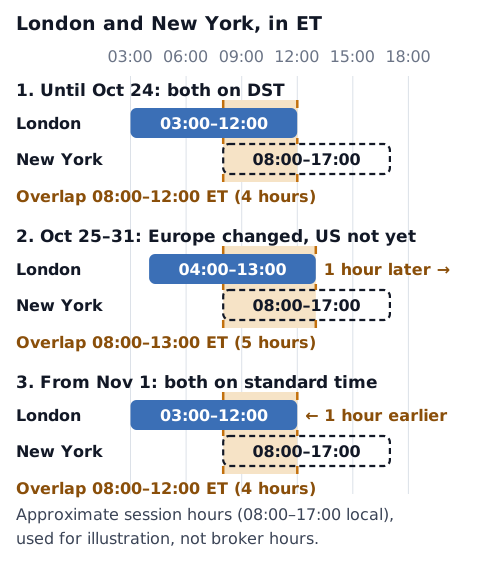
The week in between: October 26 to 30
From October 25 to 31, Europe is back on standard time while the US is still on daylight saving time. London is 4 hours ahead of New York instead of the usual 5. Some things to expect that week:
- In ET, Europe moves an hour later: the London open (8 am London) is at 4 am ET instead of 3 am. The ECB's Governing Council meets on October 28 and 29,[10] and its decisions are published at 2:15 pm Frankfurt time (the time it set in 2022),[11] which that week is 9:15 am ET, not the usual 8:15 am.
- In London, the US moves an hour earlier: US data at 8:30 am ET is released at 12:30 pm London time. The FOMC meets on October 27 and 28,[8] and its statement comes at 2 pm ET,[9] so on October 28 that is 6 pm in London, not 7 pm.
- From November 2, the usual time gap returns: the October jobs report is scheduled for Friday, November 6 at 8:30 am ET,[12] which is back to 1:30 pm in London.
Release dates and times can change, so check the central bank's or agency's own calendar in the week itself. What can happen around news releases, such as wider spreads, is covered in what happens around news releases.
MT4/MT5 server time and the daily candle
If your account has no server time (it is not an MT4/MT5 account), you can skip this section.
MT4/MT5 charts usually show your broker's server time. Many brokers use GMT+2, or GMT+3 during US daylight saving time, but not all. A broker that works this way changes its server clock with the US on November 1, not with Europe. With this setup, the server's midnight stays at 5 pm New York time all year, so the daily candle always starts at 5 pm ET. For a London trader, the same daily candle starts at 10 pm London, except in the week of October 26 to 30, when it starts at 9 pm.
Other brokers may change their server time on the European date, or not at all. Then the dates and the size of the shift are different. Either way, it is your broker's choice. Your broker's week may also open at a different time from the "trading week opens" row in the table.
How to check with your own broker
- Read your broker's announcements: changes to trading hours, maintenance windows or server time around the clock changes are usually posted on the broker's news or announcements page. Look for one before October 25 and November 1.
- Look at your MT4/MT5 clock before and after: note the time shown at the top of Market Watch, and how far it is from your own clock, during trading hours on Friday, October 23, Monday, October 26 and Monday, November 2. The clock stops while the market is closed, so check while it is open.
- Reset the offset in the converter: in the server time converter, "From your MT4/MT5 clock" saves the difference you picked. Pick your MT4/MT5 time again after the clocks change. "Common broker time (GMT+2/+3)" follows the US change automatically, but your broker may not work that way.
- See the sessions on your own clock: the forex market hours tool works out each city's daylight saving time from your device's clock, so it shows the right hours during the in-between week too.
- Check anything tied to a clock time: personal rules such as "no new trades after a certain hour", pending orders with an expiry time, and EAs (automated trading programs in MT4/MT5) or alerts that run at set times. Check which clock each one uses.
What it does to your records
Results grouped by time of day ("London session", "New York session") can shift around the clock changes.
- If you group by your local clock: in New York, the London session starts an hour later in the week of October 26. In London, the New York session starts an hour earlier that week. Elsewhere, both sessions can move on your clock, on one or both dates. An "hour of day" chart will mix two different sessions in the same hour for that week.
- If you group by MT4/MT5 history times: history times are server times. With a broker that follows the US date, New York stays in the same server hours all year, and only the London session moves, for the week of October 26 to 30.
- Where the trading day ends: if the daily candle starts at a different hour on your clock, profit and loss for a "day" counted on your clock and for a daily candle in MT4/MT5 may not match around the changes.
The trades themselves did not change; only the labels did. When you review, mark the clock-change week, or note which session a trade was in separately from the time, so you can tell them apart later. Whether to review by time of day, and when to trade, is up to you.
Weekend, holiday and year-end trading hours are covered in forex market holidays, year-end and holding over the weekend. The 2026-27 holiday dates are in forex market hours over Christmas and New Year 2026-27.
Sources
- GOV.UK. When do the clocks change? https://www.gov.uk/when-do-the-clocks-change
- Directive 2000/84/EC of the European Parliament and of the Council of 19 January 2001 on summer-time arrangements (Article 3). EUR-Lex. https://eur-lex.europa.eu/legal-content/EN/TXT/?uri=CELEX:32000L0084
- National Institute of Standards and Technology (NIST). Daylight Saving Time. https://www.nist.gov/pml/time-and-frequency-division/popular-links/daylight-saving-time-dst
- National Research Council Canada. Time zones and daylight saving time. https://nrc.canada.ca/en/certifications-evaluations-standards/canadas-official-time/time-zones-daylight-saving-time
- NSW Government. Daylight saving. https://www.nsw.gov.au/about-nsw/daylight-saving
- National Institute of Information and Communications Technology (NICT). 情報通信研究機構研究報告 (NICT research report), Vol. 65 No. 2 (2019), section 3, "サマータイム" (Summer time) [in Japanese]. https://www.nict.go.jp/publication/shuppan/kihou-journal/houkoku65-2/book/pdf/23.pdf
- Australian Foreign Exchange Committee. Q&A (Question 3). https://afxc.rba.gov.au/qa/
- Board of Governors of the Federal Reserve System. Meeting calendars, statements, and minutes. https://www.federalreserve.gov/monetarypolicy/fomccalendars.htm
- Board of Governors of the Federal Reserve System. (March 13, 2013). Federal Reserve announces time changes for FOMC statements and news conferences. https://www.federalreserve.gov/newsevents/pressreleases/monetary20130313a.htm
- European Central Bank. Meetings of the Governing Council and General Council. https://www.ecb.europa.eu/press/calendars/mgcgc/html/index.en.html
- European Central Bank. (June 27, 2022). New times for ECB's monetary policy decisions and press conference. https://www.ecb.europa.eu/press/pr/date/2022/html/ecb.pr220627~73acedf868.en.html
- U.S. Bureau of Labor Statistics. Schedule of Releases for The Employment Situation. https://www.bls.gov/schedule/news_release/empsit.htm
- Government of British Columbia, Ministry of Attorney General. (March 2, 2026). Adopting permanent daylight saving time. https://news.gov.bc.ca/releases/2026AG0013-000209
- New Zealand Government (govt.nz). Daylight saving in NZ. https://www.govt.nz/browse/recreation-and-the-environment/daylight-saving