First, think of changing money
Have you ever changed money, for a trip abroad or to pay for something priced in another currency? If the exchange rate moves after you change it, the amount you get when you change it back is different too. The diagram uses British pounds and US dollars, but it works the same with naira, rand, rupees, pesos, Australian dollars or any other currency: if your money is in US dollars, think of changing US dollars into euros or pounds and back.
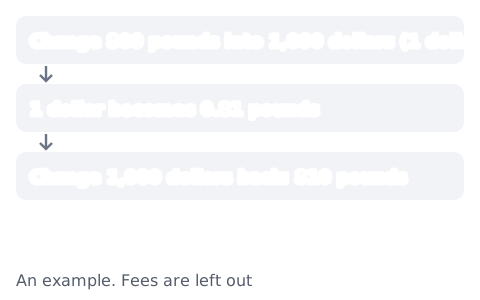
Forex uses this difference in the exchange rate. In real forex trading, though, you usually do not receive the currency itself; only the difference when you close the trade is added to or taken from your account as a profit or loss.
How a trade works
A single forex trade can be split into roughly five steps.
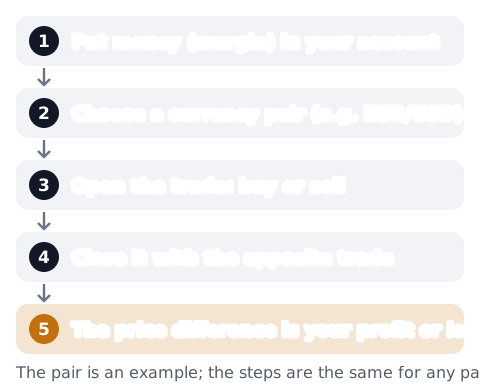
- Account: a trading account you open with a forex broker.
- Margin: money you deposit in the account in order to trade. It is explained later in this article.
To close a trade, you make the opposite trade. For example, if you bought euros with US dollars, you close by selling euros for US dollars.[2] The difference between the opening and closing prices becomes your profit or loss.
How to read a currency pair
Forex prices are shown as two currencies paired together, such as "EUR/USD", because when you buy one currency you are selling the other.[2] This is called a currency pair.
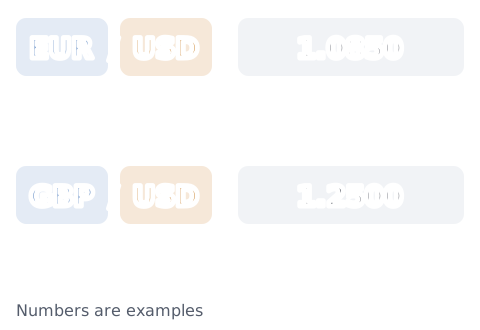
- The left currency (base currency): the currency counted as one unit.[2]
- The right currency (quote currency): the price (rate) is the amount of this currency needed to buy one unit of the left currency.[2]
Currencies are written as three-letter codes, such as EUR (euro), USD (US dollar), JPY (Japanese yen) and GBP (British pound).[2] You can look up common terms in the glossary.
Buying and selling
In forex you can open a trade by buying or by selling. Buying a pair means buying the left currency and selling the right one; selling a pair is the opposite.[2]
Selling something you do not own may sound strange. In forex, selling means selling first and buying back later to close. If you buy back cheaper than you sold, the difference is your profit. For example, sell EUR/USD at 1.0950 and buy back at 1.0850, and the 0.0100 difference is your profit. Only the order is reversed (sell first, buy later). In other words, it is the trade people use when they think the price will fall.
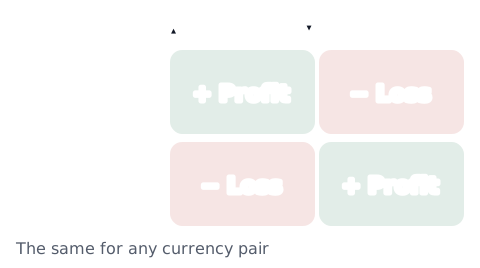
For example, with EUR/USD, buy 10,000 euros at 1.0850 and close by selling at 1.0950: (1.0950 − 1.0850) × 10,000 = a 100 US dollar profit. Open the same 10,000 euros by selling at 1.0850 and buy back at 1.0950, and it is a 100 US dollar loss (our own example, with costs left out).
So the profit or loss is the price difference × the trade size.[2] To work it out for your own size, use the profit and loss calculator. The lesson on how to calculate forex profit goes into more detail.
The buy price and the sell price
A broker's screen usually shows two prices: the price you can sell at (the bid) and the price you can buy at (the ask).[2]
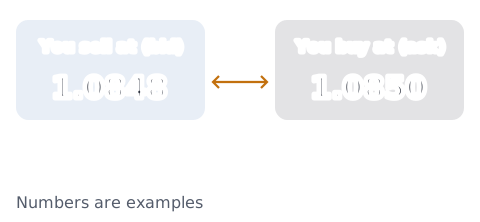
For example, an EUR/USD quote of 1.0848/1.0850, as in the diagram, means you can sell one euro for 1.0848 US dollars and buy one for 1.0850 US dollars (our own example; the NFA guide reads quotes the same way).[2] This gap is called the spread. If you buy and sell straight away, you lose the gap even if the market has not moved. The lesson on what the spread is looks at when it widens.
You can trade more than you deposit
In forex you deposit only part of the trade's value, called margin. How much you need depends on where you trade.
- European Union: the European Securities and Markets Authority (ESMA) limited leverage for retail clients to 30 to 1 (often written 1:30) on major currency pairs in its 2018 measures for CFDs. That means a margin of about 3.3%.[4]
- UK: the Financial Conduct Authority (FCA) made similar rules permanent in 2019, limiting leverage for retail clients to between 30:1 and 2:1.[5] In the UK, these rules on CFDs also cover spread bets and rolling spot forex.[5]
- Japan, for example: the Financial Services Agency (FSA) says individual traders must deposit and keep margin of at least 4% of the trade's value.[1] At 4%, a deposit of 10,000 (in any currency) lets you trade up to 250,000 (25 times).
Limits in other countries and regions are in forex leverage limits by country.
Controlling a larger amount than you deposit is called leverage.[2] With high leverage, a small price move becomes a large profit or loss compared with your deposit.[2] The US Commodity Futures Trading Commission (CFTC) warns that you may be liable for additional losses beyond your initial deposit.[3] Japan's Financial Services Agency also describes it as a very high-risk product that can cause losses larger than the margin you deposited.[1]
How losses beyond your deposit are handled depends on the rules where you trade and on the broker. In the EU, for example, ESMA's 2018 measures also limited a retail client's losses to the money in their account.[4] In the UK, the FCA's rules likewise require that a retail client cannot lose more than the total funds in their CFD account (negative balance protection).[5] For more, see what is a stop out. The lesson on margin and margin level explains the details.
Many people lose money
Figures published by regulators show that a large share of retail traders lose money.
- United States: the Commodity Futures Trading Commission (CFTC) says that over one year, about one-third of customers at registered forex dealers made a profit and about two-thirds lost money (second quarter of 2021 to first quarter of 2022).[3]
- European Union: the European Securities and Markets Authority (ESMA) says analyses by national authorities found that 74–89% of retail accounts typically lose money.[4] This figure covers CFDs in general (contracts where only the price difference is settled), not only forex.
These figures vary with the country, period and type of product, and they do not apply to any one person. Still, they are worth knowing before you start.
What comes next in this course
From here, the course looks at the trading screen and candlesticks, what to watch for when choosing a broker, counting profit and loss, margin and leverage, and orders, one at a time. You can go on to the next lesson from the links at the bottom of this page. No lesson gives trade calls or market forecasts. Use them as material for making your own decisions.
Sources
- Financial Services Agency, Japan. (Updated February 21, 2020). いわゆる外国為替証拠金取引について (About so-called foreign exchange margin trading) [in Japanese]. https://www.fsa.go.jp/ordinary/iwagai/
- National Futures Association (US futures industry self-regulatory organization). (2004). Trading in the Retail Off-Exchange Foreign Currency Market: What Investors Need to Know (PDF pp. 2–7). Copy hosted by Nasdaq: https://www.nasdaqtrader.com/content/phlxwco/forex.pdf
- U.S. Commodity Futures Trading Commission. Customer Advisory: Eight Things You Should Know Before Trading Forex. https://www.cftc.gov/LearnAndProtect/AdvisoriesAndArticles/CustomerAdvisory_MustKnowForex.html
- European Securities and Markets Authority. (March 27, 2018). ESMA agrees to prohibit binary options and restrict CFDs to protect retail investors. https://www.esma.europa.eu/press-news/esma-news/esma-agrees-prohibit-binary-options-and-restrict-cfds-protect-retail-investors
- Financial Conduct Authority. (July 1, 2019). FCA confirms permanent restrictions on the sale of CFDs and CFD-like options to retail consumers. https://www.fca.org.uk/news/press-releases/fca-confirms-permanent-restrictions-sale-cfds-and-cfd-options-retail-consumers