What you trade
- Forex (retail margin forex): you buy and sell a pair of currencies. Your profit or loss is the difference between the price you buy at and the price you sell at. Because the two currencies have different interest rates, you may also receive or pay swap (rollover). You deposit margin and trade an amount several times larger (leverage). See what is forex for the basics.
- Stocks: you buy a share of ownership in a company. Money comes from the share price rising and from dividends, when the company pays out part of its earnings.[12]
- Long-term index investing: a stock index such as the S&P 500 measures the performance of a "basket" of shares. You cannot invest in an index directly, so you buy an index fund (a mutual fund or ETF) that seeks to track it.[13] Index funds have generally followed a passive style, not buying and selling very often.[13]
- Crypto: you buy and sell digital assets. The US Commodity Futures Trading Commission (CFTC) says they are not backed by any government or central bank, and their value comes entirely from supply and demand.[10]
- Binary options: you choose between two outcomes, such as whether a currency or index will be above or below a set level at a set time. You pay a premium; if you are right, you receive a fixed payout, and if you are wrong, you receive nothing and lose the premium.[9][15]
Side-by-side table
Scroll the table sideways →
| Item | Forex | Stocks | Long-term index investing | Crypto | Binary options |
|---|---|---|---|---|---|
| What you trade | Currency pairs | A share of a company[12] | A fund or ETF that tracks an index[13] | Crypto assets[10] | A contract on whether a price meets a condition at a set time[15] |
| How money is made or lost | Price difference between buying and selling; swap received or paid | Price going up or down; dividends[12] | Prices of the shares in the index going up or down[13] | Price going up or down[10] | A fixed payout if right; the premium is lost if wrong[15] |
| Borrowing to trade bigger (leverage) | You trade several times your margin; limits differ by country and region[1][7] | Cash accounts, and margin accounts that borrow to buy[11] | Usually bought with your own money | Buying with your own money, or margin products such as futures[10] | You pay a premium for each trade[15] |
| Trading hours | The market is said to run 24 hours somewhere in the world[20]; your broker sets its own hours | Set by the exchange and your broker | Set by the exchange or the fund provider | Set by the exchange or platform | Set by the provider |
| Main costs | Spread (the gap between buy and sell prices), swap paid | Commissions and other fees (vary by broker) | Commissions, plus ongoing fund expenses while you hold it[13] | Platform fees and the gap between buy and sell prices (vary by platform) | The premium; the payout is fixed in advance[15] |
| How much you can lose at most | Can be more than your margin[21] (the UK, Australia and most EU countries, as of ESMA's 2019 announcement, limit retail losses to the funds in the account[3][4][7]) | With your own money, what you put in; with borrowed money, it can be more[11] | With your own money, what you put in | With your own money, what you put in; with margin, it can be more[10] | Up to the premium per trade; repeated trades add up[15] |
| Examples of rules (differ by country and region) | Some countries and regions set leverage limits (limits by country) | Securities rules where you live | Fund and securities rules where you live | Japan: exchanges must be registered[16]. UK: sale of certain crypto derivatives to retail consumers is banned[6] | UK and Australia: sale to retail clients is banned[5][8]. Most EU countries restrict them under national rules (as of ESMA's 2019 announcement)[2]. Japan: registration required[15] |
| Tax | Tax rules depend on the product and on the country or region. Check with the tax authority where you live. | ||||
(Checked against official regulator documents on October 14, 2026. Rules can change. Costs depend on the provider and product, so the table gives no figures.)
Tax shows how much the product and the country matter. In the UK, for example, people also trade price moves through CFDs and spread bets (such as a bet on the FTSE 100 index), and HMRC, the UK tax authority, treats them differently. HMRC's manual says gains and losses on retail CFDs fall under capital gains tax in almost every case, unless they are taxed as trading income, while spread betting gives no chargeable gains or allowable losses. Treatment depends on your situation and can change.[28][29] Shares in a stocks and shares ISA (Individual Savings Account) have their own tax rules, with a yearly limit on how much you can put in.[30] This is not tax advice; check with the tax authority where you live.
How much can you lose at most?
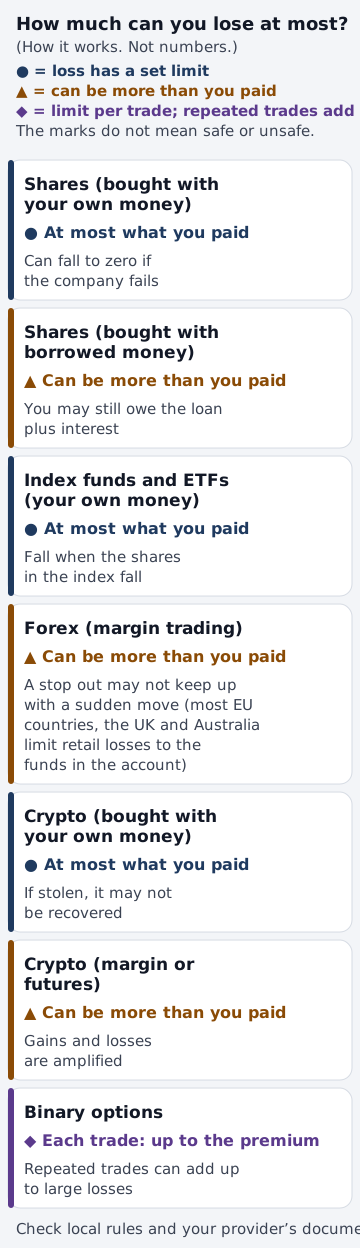
- Your own money: a price cannot go below zero, so you can lose at most what you put in, but you can lose all of it.[12]
- Borrowed money or margin: you can lose more than you put in.[10][11] In forex, a stop out may not keep up with a sudden move.[19] The UK, Australia and most EU countries (for the EU, as of ESMA's 2019 announcement) have negative balance protection, which stops providers from making retail clients lose more than the funds in the account.[3][4][7]
How forex stop outs work is in what is a stop out.
Common things to watch
- Forex: because of leverage, a small price move can mean a large gain or loss compared with your margin. A 2018 EU decision required CFD providers (including CFDs on currency pairs) to show a standard warning that "between 74-89% of retail investor accounts lose money when trading CFDs" (the version for providers without their own figure; the figure comes from national regulators' analyses at the time, not a current rate).[1] Check your broker's stop out level and what happens if losses exceed your margin.[19] Some brokers offer accounts without swap; for questions of religious permissibility, please ask a scholar or adviser of your faith.
- Stocks: prices go down as well as up, and there is no guarantee a company will do well.[12] The US Securities and Exchange Commission (SEC) describes day trading, buying and selling within the day, as extremely risky, with the possibility of substantial losses in a very short time.[14]
- Long-term index investing: an index fund carries the same general risks as the securities in its index. It may also trail its index because of fees, trading costs and tracking error. Not all index funds cost less than actively managed funds, so the SEC advises checking the actual cost before investing.[13]
- Crypto: prices can swing sharply.[10] The CFTC notes there may be no recourse if your crypto is stolen.[10] In Japan, the Financial Services Agency (FSA) reports a rise in consultations about crypto and fraudulent coins.[16]
- Binary options: they look simple, but the SEC and CFTC have warned of fraud complaints: platforms refusing to return deposits, identity theft, and software manipulated to produce losing trades.[9] Japan's FSA, for example, also describes them as difficult products that need specialist knowledge and careful risk management. Because each loss is limited, they are easy to mistake for low-risk, and repeating short trades can lead to large losses.[15]
Whichever you look at, be careful with social media offers that promise sure profits. The person recommending a provider may be paid a referral fee by it (see social media "pro traders"). Before you trade, you can check whether a firm is registered using public search tools:
- United Kingdom: the FCA's Financial Services Register[18]
- United States: FINRA's BrokerCheck and the NFA's BASIC. The SEC and CFTC advise not trading with a firm whose registration you cannot verify.[9]
- Australia: ASIC's Professional Registers. ASIC advises checking that the license number and company details you are given match its registers, and that the license conditions cover the services offered.[27]
- India: the Reserve Bank of India (RBI) publishes an Alert List of entities not authorized to deal in forex or to run forex trading platforms. It says the list is not exhaustive, and a firm not on it should not be assumed to be authorized.[22]
- Japan: the FSA's list of licensed and registered firms[17]
Regulators in other countries and regions often have similar search tools; registers in Australia, Canada, Singapore, South Africa and other places are listed in how to check a forex broker. See also the risks of unregistered brokers.
Rules differ by country and region
- European Union: in 2018 the European Securities and Markets Authority (ESMA) adopted temporary measures that prohibited selling binary options to retail clients and set conditions for retail CFDs, including minimum margin, closing positions when funds fall too low, and limiting losses to the funds in the account.[1] Both measures were allowed to expire in 2019 (binary options on July 1, CFDs on July 31) because most national authorities had adopted measures at least as strict (as of ESMA's 2019 announcement).[2][3]
- United Kingdom: the Financial Conduct Authority (FCA) banned selling binary options to retail consumers from April 2, 2019.[5] Since August 1, 2019, a retail client's liability on CFDs and similar products has been limited to the funds in the account.[4] From January 6, 2021 it also banned selling derivatives (CFDs, options and futures) on certain cryptoassets to retail consumers.[6]
- Australia: since March 29, 2021, the Australian Securities and Investments Commission (ASIC) has set conditions on retail CFDs, including leverage limits and negative balance protection (extended to May 23, 2027).[7] Since May 3, 2021 it has banned selling binary options to retail clients (extended to October 1, 2031).[8]
- United States: the SEC and CFTC warn that much of the binary options market runs on internet platforms that may not comply with US rules.[9]
- India: the RBI says residents can trade forex only with authorized persons and for permitted purposes, and electronically only on platforms the RBI has authorized or on recognized Indian stock exchanges.[22]
- Japan: a business that exchanges crypto for money must be registered as a crypto exchange service provider.[16] In July 2026, Japan passed a law moving the main crypto rules under the Financial Instruments and Exchange Act; it was promulgated on July 23. Check the FSA's announcements for when the new rules take effect.[31] Offering binary options to people living in Japan as a business also requires registration, even for firms licensed in another country.[15]
These are only a few examples, and rules elsewhere are different. Check with the regulator where you live.
Things to check yourself
- Maximum loss: at most what you put in, or possibly more
- Costs and tax: what you pay on each trade, what you pay while you hold, and how it is taxed
- The provider: registered or licensed where you live
- The rules: whether the product is allowed for retail customers where you live
To see how much margin a forex trade size needs, use the margin calculator.
This page explains differences for comparison only. The decision about any product is yours. If you are unsure, talk to a public advice service or the regulator's consumer helpline where you live. For example, in the UK the FCA's contact page directs people reporting a scam to Report Fraud (0300 123 2040)[23]; in the US the CFTC takes tips and complaints about possible violations of US commodity law, including suspected fraud[24]; in Australia, ASIC says to report all scams, including investment scams, to Scamwatch[25]; ASIC says firms covered by its dispute resolution rules must be members of the Australian Financial Complaints Authority (AFCA), and that AFCA can handle complaints that the firm could not resolve internally[26], so check whether the firm is an AFCA member before you rely on it; in Japan there are the FSA's counseling office for financial services users and the consumer hotline (188).[16] If you find it hard to stop trading, or keep wanting to win back losses, gambling and addiction support services where you live can also help.
Sources
- European Securities and Markets Authority. (2018). Notice of ESMA's Product Intervention Decisions in relation to contracts for differences and binary options (ESMA35-43-1135, decisions of May 22, 2018). https://www.esma.europa.eu/sites/default/files/library/esma35-43-1135_notice_of_pi_decisions_on_cfds_and_binary_options.pdf
- European Securities and Markets Authority. (2019). ESMA ceases renewal of product intervention measure relating to binary options. https://www.esma.europa.eu/press-news/esma-news/esma-ceases-renewal-product-intervention-measure-relating-binary-options
- European Securities and Markets Authority. (2019). ESMA ceases renewal of product intervention measures relating to contracts for differences. https://www.esma.europa.eu/press-news/esma-news/esma-ceases-renewal-product-intervention-measures-relating-contracts
- Financial Conduct Authority. FCA Handbook, COBS 22.5 (COBS 22.5.17, from August 1, 2019). https://handbook.fca.org.uk/handbook/cobs22/cobs22s5
- Financial Conduct Authority. (March 29, 2019). FCA confirms permanent ban on the sale of binary options to retail consumers. https://www.fca.org.uk/news/statements/fca-confirms-permanent-ban-sale-binary-options-retail-consumers
- Financial Conduct Authority. (October 6, 2020). FCA bans the sale of crypto-derivatives to retail consumers. https://www.fca.org.uk/news/press-releases/fca-bans-sale-crypto-derivatives-retail-consumers
- Australian Securities and Investments Commission. (2022). 22-082MR ASIC's CFD product intervention order extended for five years. https://asic.gov.au/about-asic/news-centre/find-a-media-release/2022-releases/22-082mr-asic-s-cfd-product-intervention-order-extended-for-five-years/
- Australian Securities and Investments Commission. (2022). 22-243MR ASIC's binary options ban extended until 2031. https://asic.gov.au/about-asic/news-centre/find-a-media-release/2022-releases/22-243mr-asic-s-binary-options-ban-extended-until-2031/
- Commodity Futures Trading Commission, U.S. Securities and Exchange Commission. CFTC/SEC Investor Alert: Binary Options and Fraud. https://www.cftc.gov/LearnAndProtect/AdvisoriesAndArticles/fraudadv_binaryoptions.html
- Commodity Futures Trading Commission. Customer Advisory: Understand the Risks of Virtual Currency Trading. https://www.cftc.gov/LearnAndProtect/AdvisoriesAndArticles/understand_risks_of_virtual_currency.html
- U.S. Securities and Exchange Commission. Investor Bulletin: Understanding Margin Accounts. https://www.sec.gov/investor/alerts/ib_marginaccounts.pdf
- U.S. Securities and Exchange Commission (Investor.gov). Stocks - FAQs. https://www.investor.gov/introduction-investing/investing-basics/investment-products/stocks
- U.S. Securities and Exchange Commission (Investor.gov). (August 6, 2018). Investor Bulletin: Index Funds. https://www.investor.gov/additional-resources/news-alerts/alerts-bulletins/investor-bulletin-index-funds
- U.S. Securities and Exchange Commission (Investor.gov). Day Trading. https://www.investor.gov/introduction-investing/investing-basics/glossary/day-trading
- Financial Services Agency, Japan. (February 28, 2020, updated June 28, 2024). バイナリーオプション取引にあたってご注意ください! (A caution about binary options trading) [in Japanese]. https://www.fsa.go.jp/ordinary/chuui/binary.html
- Financial Services Agency, Japan. 暗号資産の利用者のみなさまへ (For users of crypto assets) [in Japanese]. https://www.fsa.go.jp/policy/virtual_currency/index.html
- Financial Services Agency, Japan. 免許・許可・登録等を受けている事業者一覧 (List of licensed and registered firms) [in Japanese]. https://www.fsa.go.jp/menkyo/menkyo.html
- Financial Conduct Authority. Financial Services Register. https://register.fca.org.uk/
- The Financial Futures Association of Japan. 学ぼう!FX #9 ロスカット取引について (Loss-cut transactions) [in Japanese]. https://www.ffaj.or.jp/learning/?p=27
- The Financial Futures Association of Japan. 学ぼう!FX #1 外国為替市場の仕組み (How the foreign exchange market works) [in Japanese]. https://www.ffaj.or.jp/learning/?p=5
- U.S. Commodity Futures Trading Commission. Customer Advisory: Eight Things You Should Know Before Trading Forex. https://www.cftc.gov/LearnAndProtect/AdvisoriesAndArticles/CustomerAdvisory_MustKnowForex.html
- Reserve Bank of India. (September 7, 2022). RBI issues Alert List of entities not authorised to deal in forex and to operate electronic trading platforms for forex transactions. https://www.rbi.org.in/scripts/BS_PressReleaseDisplay.aspx?prid=54333
- Financial Conduct Authority. Contact us. https://www.fca.org.uk/contact
- Commodity Futures Trading Commission. Submit a Tip. https://www.cftc.gov/complaint
- Australian Securities and Investments Commission. Scams. https://www.asic.gov.au/regulatory-resources/scams
- Australian Securities and Investments Commission. Dispute resolution. https://asic.gov.au/regulatory-resources/financial-services/dispute-resolution/
- Australian Securities and Investments Commission. Use ASIC's resources to help avoid scams. https://www.asic.gov.au/regulatory-resources/scams/use-asic-s-resources-to-help-avoid-scams/
- HM Revenue & Customs. Capital Gains Manual, CG56100: Futures: financial futures: contracts for differences. https://www.gov.uk/hmrc-internal-manuals/capital-gains-manual/cg56100
- HM Revenue & Customs. Capital Gains Manual, CG56105: Futures: financial futures: financial spread betting. https://www.gov.uk/hmrc-internal-manuals/capital-gains-manual/cg56105
- GOV.UK. Individual Savings Accounts (ISAs). https://www.gov.uk/individual-savings-accounts
- House of Councillors, Japan. Bill information: 金融商品取引法及び資金決済に関する法律の一部を改正する法律案 (Bill to amend the Financial Instruments and Exchange Act and the Payment Services Act) — passed July 15, 2026, promulgated July 23, 2026 as Act No. 64 [in Japanese]. https://www.sangiin.go.jp/japanese/joho1/kousei/gian/221/meisai/m221080221057.htm