What regulators warn about
- United States (CFTC): in its warning about social media scams, the CFTC says photos of exotic vacations, sports cars and mansions are common, and posts may feature screenshots of "winning trades" or huge account balances.[2]
- United Kingdom (FCA): in its 2024 warning to firms and "finfluencers" (financial influencers), the FCA says promoting a financial product without approval from an FCA-authorized person with the right permission could be a criminal offense.[7]
- Australia (ASIC): ASIC's information sheet for social media influencers (INFO 269, March 2022) says influencers who give financial product advice must hold a license unless they are exempt or authorized as a representative, and that being paid for comments on financial products makes it more likely they are giving advice. It says influencers may have to disclose payments or benefits to their followers.[8]
- Japan (FSA): on offers to invest in forex and crypto, the FSA says it receives many inquiries from people who invested after being approached by someone they met on social media. It also describes people pushing forex, binary option or crypto investments with claims like "use automated trading software and you can make money without doing anything".[1]
Why some recommend sign-ups: referral pay
People or firms that bring customers to a broker are called introducing brokers (IBs) or affiliates. The US National Futures Association describes an IB as someone who solicits or accepts orders from customers but does not accept customers' money.[3]
The UK FCA has raised concerns that firms offering CFDs (contracts for difference, a type of leveraged trading product) pay affiliates that are not authorized by the regulator, such as social media "influencers", to introduce clients, and that firms profit excessively when customers can be persuaded to trade more often or in larger sizes than is in their best interests.[4] The EU's ESMA says firms must manage conflicts of interest (when what is good for the firm and what is good for the client pull in different directions) that can arise from pay between the parties, which could encourage behavior that is not in retail clients' best interests.[5]
So if a referrer's pay depends on your sign-up or how much you trade, the more you sign up and trade, the more they may earn. Their reason for recommending something may not be to help you.
Being paid for referrals is not always wrong, and rules differ by country. Some people clearly disclose that they are paid and share results that can be checked. This article is not criticizing everyone who posts about trading. What matters is whether the pay is disclosed and whether the results can be verified.
A study of how social media posters performed
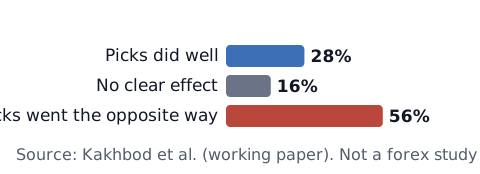
A study of people posting stock investment ideas on one social media platform (published as a Swiss Finance Institute working paper) sorted them by how their recommendations performed afterwards: the picks of 28% did well, 16% showed no clear effect, and the picks of 56% tended to move the opposite way (the paper calls them "antiskilled"). These posters tended to have more followers than those whose picks did well.[6]
This is a study of stock posts, and it may not carry over to forex. Still, it is one result showing that a large following is not proof of good results.
What to check when someone recommends a broker (you decide)
- Are they paid? Is there a referral link or code, or a note saying they are paid?
- Can the results be checked? Are they only screenshots? Do they include every trade, losses too?
- Is the broker authorized? Search for your country's financial regulator and its public register of authorized firms, and look the broker up there (see brokers not registered where you live)
- Which company, which regulator? Find the company's full legal name in the account agreement and the regulator the broker names, then search that exact name in that regulator's own register (see how to check a forex broker)
- "Money without doing anything"? Japan's FSA, for example, lists this phrase in its warning[1]
If something goes wrong or you have lost money, you do not have to deal with it alone: contact the financial regulator where you live. In Australia, for example, ASIC says to report all scams, including investment scams, to Scamwatch[9]. A complaint about a financial firm goes to the firm first; ASIC says firms covered by its dispute resolution rules must be members of the Australian Financial Complaints Authority (AFCA), which can resolve complaints the firm could not.[10] Check whether the firm is an AFCA member before you rely on it. In Japan, the FSA's Counseling Office for Financial Services Users takes consultations, including on investment products and crypto (in Japanese).[11] This article does not decide whether to try someone's method. If you do, checking your own results in your records lets you compare them with what was promised. The trading stats calculator turns a profit and loss list into win rate and averages.
Sources
- Financial Services Agency, Japan. Caution on solicitation for FX and crypto-asset investment (Japanese). https://www.fsa.go.jp/ordinary/chuui/husyouseikanyuu.html
- Commodity Futures Trading Commission. There's Nothing to Like About Scammers on Social Media. https://www.cftc.gov/ConsumerProtection/FraudAwarenessPrevention/CFTCFraudAdvisories/nothing_to_like_about_social_media_scammers.html
- National Futures Association. Introducing Broker. https://www.nfa.futures.org/registration-membership/who-has-to-register/ib.html
- Financial Conduct Authority. Contracts for Difference. https://www.fca.org.uk/firms/contract-for-differences
- European Securities and Markets Authority. (2016). ESMA publishes updated Q&A on CFDs and other speculative products. https://www.esma.europa.eu/press-news/esma-news/esma-publishes-updated-qa-cfds-and-other-speculative-products
- Kakhbod, A., Kazempour, S. M., Livdan, D., & Schürhoff, N. (2023). Finfluencers. Swiss Finance Institute Research Paper No. 23-30. https://sfi.ch/de/publications/n-23-30-finfluencers
- Financial Conduct Authority. (March 26, 2024). FCA warns firms and finfluencers to keep their social media ads lawful. https://www.fca.org.uk/news/press-releases/fca-warns-firms-and-finfluencers-keep-their-social-media-ads-lawful
- Australian Securities and Investments Commission. (March 2022). Discussing financial products and services online (INFO 269). https://www.asic.gov.au/regulatory-resources/financial-services/giving-financial-product-advice/discussing-financial-products-and-services-online
- Australian Securities and Investments Commission. Scams. https://www.asic.gov.au/regulatory-resources/scams
- Australian Securities and Investments Commission. Dispute resolution. https://asic.gov.au/regulatory-resources/financial-services/dispute-resolution/
- Financial Services Agency, Japan. 金融サービス利用者相談室 (Counseling Office for Financial Services Users) [in Japanese]. https://www.fsa.go.jp/receipt/soudansitu/index.html