Before you open an account or send money, check these three things against your regulator's register:
- The name (the firm's full legal name)
- The registration number (the number the regulator gave the firm)
- The official contact details (website, phone and address)
Trust the contact details in the register, not the number or contact details the firm gave you. To find the right register, see the table by country and region below. If your country is not in the table, find the name of your regulator in the regulator column of the I-SCAN list, then search on that regulator's official website.
If you do decide to open an account, decide how much you are willing to lose per trade before your first order. The position size calculator and the margin calculator help with the arithmetic. This page does not recommend any broker.
The three checks at a glance
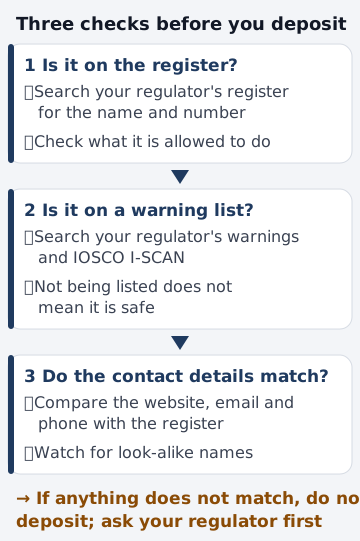
1. Is it on the register?
In many countries and regions, firms offering forex and similar products need to be registered or authorized by a regulator. Regulators publish lists of these firms, called registers, which you can search by name or registration number.
Finding the name is not the end. Also check whether the firm is allowed to offer what it is offering you. The UK's FCA, for example, tells consumers to use its Firm Checker to see whether a firm is authorized and has permission to provide the services you want.[1]
Check which company your account would be with. Some broker brands use more than one company, in different countries. A website may show a regulator's name or logo that belongs to a different company from the one you would sign with. So:
- Find the company's full legal name in the client agreement or terms (often at the bottom of the website, too).
- Note which regulator the broker says authorized that company, and the registration number.
- Search that exact company name in that regulator's own register, and check that the number matches.
- Any protections usually follow the rules of the country that authorized that company, which may not be where you live.
2. Is it on a warning list?
Many regulators publish warning lists of firms they believe are operating without registration or permission. You can search them by name or by website address.
The key point: not being on a list does not mean a firm is safe. Regulators in Australia, Singapore and Hong Kong say their lists are not complete (see the table). Japan's FSA also says firms not on its list may still be operating without registration.[13]
3. Do the contact details match the register?
Even if the name is on the register, the person who contacted you may not be from that firm. The FCA advises checking that the registration number and contact details you were given match the Firm Checker, and always using the contact details shown on the Firm Checker.[3]
The US National Futures Association (NFA) likewise tells investors to make sure the name, main business address and phone number on its BASIC search exactly match those of the firm contacting them.[4] More on this under clone firms.
Registers and warning lists by country and region
Use the regulator where you live. The table is in alphabetical order. Every page was opened and checked on October 14, 2026. Regulators can move or change their pages.
| Country or region | Search registered firms | Warnings and alerts | Things to know |
|---|---|---|---|
| Australia | Professional Registers search (people and firms registered or licensed with ASIC), on ASIC's "Search ASIC registers" page[19] | Moneysmart (ASIC) Investor alert list[6] | Lists firms and websites that may be targeting Australian consumers and do not hold an ASIC license. Says the list is not exhaustive and is based on the information ASIC had at the time. ASIC also advises checking that the AFS license number and company details you are given match its registers, and that the license conditions cover the services offered[28] |
| Brazil | "Regulados CVM" (search for regulated firms) on CVM's "Proteção" page[7] | "Alertas" on the same page, on irregular offers and activity[7] | The page is in Portuguese |
| Canada | CSA "Are They Registered?"[8] | Investor alerts, the fifth check on the same page[8] | Walks you through five checks: registration, disciplinary history, news and web searches, tools, and investor alerts |
| EU | ESMA Investor Corner, which links to ESMA's register and to national regulators[9] | Links to IOSCO's alerts from the same page[9] | Says to always check with your own national regulator, and not to treat the absence of an IOSCO warning as proof a firm is legitimate |
| Hong Kong | SFC Public Register of Licensed Persons and Registered Institutions (search by name or CE number)[20] | SFC Alert List[10] | Says the list is not comprehensive and is not a substitute for your own checks |
| India | SEBI list of registered intermediaries[11] | RBI (Reserve Bank of India) Alert List of entities not authorized to deal in forex or to run electronic trading platforms for forex[21] | The SEBI page also lists canceled and suspended registrations. The RBI says its Alert List is not exhaustive, and a firm not on it should not be assumed to be authorized. It says residents can trade forex only with authorized persons and for permitted purposes[21] |
| Japan | FSA list of licensed and registered firms[12] | FSA list of firms warned for operating without registration[13] | Searchable by name or phone number. The FSA says firms not on its warning list may still be operating without registration |
| Nigeria | SEC Nigeria "Find a Registered Operator" (capital market operators such as brokers and investment advisers)[31] | SEC Nigeria "Known Investment Scams"[32] | The SEC says you can verify an operator's credentials and confirm its registration status there, and that investors should still do their own due diligence[31]. A broker based in another country may not be registered with the SEC, so it may not appear there. If it is not there, note which regulator the broker says authorized it and follow these steps |
| Singapore | MAS Financial Institutions Directory (search by name, license type or activity)[22] | MAS Investor Alert List[14] | Says the list is not exhaustive, and suggests checking official contact details in the MAS Financial Institutions Directory |
| South Africa | FSCA "Check if a firm is authorised" search, on its "Regulated People and Entities" page[25] | — | The FSCA says the search lets you confirm the registration status of financial services providers |
| United Kingdom | FCA Firm Checker[1] | FCA Warning List of unauthorised firms[2] | Says to always use the contact details on the Firm Checker[3] |
| United States (futures and forex) | NFA BASIC[15] | CFTC "Learn & Protect", which links to the RED List (Registration Deficient list)[16] | An NFA ID alone does not show NFA membership. Check that the name, address and phone match BASIC[4] |
| United States (securities) | FINRA BrokerCheck[17] | — | For securities brokers and advisers. Search futures and forex firms on NFA BASIC |
Scroll the table sideways to see every column.
If your country is not in the table, find the name of your regulator in the regulator column of the I-SCAN list, then search on that regulator's official website. A "—" in the warnings column means this page does not cover it, not that there is no warning list.
Searching across countries: how to use I-SCAN
I-SCAN is a page run by IOSCO where you can search warnings from regulators around the world in one place. When we looked on October 14, 2026, it held about 47,000 warnings.[5] It helps when you do not know which country a firm is really in.
- Open I-SCAN yourself: type IOSCO's address (https://www.iosco.org/i-scan/) rather than using a link from search results or from the firm.
- Use "Filter" to search: search by the firm's name and by its website address. Searching both helps you catch more.
- See which regulator issued the warning: results show the name, corporate name, website, the regulator that issued the warning, and the date. "View More" shows the details.
- Check your own regulator too: even if I-SCAN finds nothing, check the register and warning list of the regulator where you live (see the table above).
IOSCO says the information is submitted by its member regulators and that it does not independently verify all of it.[5] ESMA also warns not to treat the absence of a warning on IOSCO's portal as proof a firm is legitimate.[9]
Impersonation and clone firms
Some firms pretend to be a real, registered firm by copying its name or registration number. The FCA calls these clone firms and warns consumers about them. It says they may copy a real firm's website with small changes, such as a different phone number.[3][23]
- Use the register's contact details: because some firms pretend to be authorized firms, the FCA says to always use the contact details on the Firm Checker.[3]
- If someone contacts you out of the blue: the FCA says scammers often call out of the blue and may also use email, text or social media. If you feel pressured to act quickly, it advises hanging up and ignoring the messages.[3]
- Do not open the register from a link: the FCA says to go to the Firm Checker by typing its address, and never through links in emails or on company websites, because the link could be part of the scam.[3]
- If they say the register is out of date: the FCA says clone firms may even claim the contact details on the Firm Checker are out of date, which is unlikely because the FCA updates it about every 24 hours on average.[23]
- Watch for look-alike names: the NFA says illegitimate firms sometimes use names similar to those of real NFA members.[4]
- A number is not enough: the NFA says an NFA ID alone does not show NFA membership. Check that the name, main business address and phone number exactly match BASIC.[4]
Even when the name is on a register, go on to check 3: whether the contact details match.
If someone pitches you on social media
Regulators warn about this. The UK's FCA, for example, says scammers often contact people out of the blue and may use social media as well as calls, email and text.[3] In Japan, the FSA says it receives many reports and inquiries from people who invested after being approached by someone they met on social media.[18] If someone on social media urges you to open an account or deposit money, you do not have to decide on the spot. You can check in this order. The same goes for pitches in chat apps such as Telegram, WhatsApp or LINE (these are only examples).
- Are they paid for referrals? Are they paid by the broker for sign-ups? Is there a referral link or code? How referral pay works is covered in Be careful with social media "pro traders".
- The firm's full name, registration number and regulator: ask the person, or look on the firm's website and in its client agreement. If you cannot find them, you cannot check the firm yet. See which company your account would be with.
- The three checks: run the register, warning list and contact checks with the regulator where you live.
- If you cannot check it, do not deposit: even if you are told it is "today only" or to hurry, you can wait until you have finished checking.
If the broker is not registered where you live
Rules and protections can differ depending on whether a firm is registered where you live, so check what your own regulator says. Protections usually follow the rules of the country that authorized the firm (see which company your account would be with), and the complaint and compensation services where you live may not cover it. The UK's FCA, for example, says that if you deal with a firm that is not authorized, you will not have access to the Financial Ombudsman Service or be protected by the Financial Services Compensation Scheme (FSCS) if the firm goes out of business.[35] In India, the RBI says residents can trade forex only with authorized persons and for permitted purposes.[21] In Japan, the leverage limit, tax and how margin is held can also change (details in Japanese). More is in trading with a broker not registered where you live.
About this page
This page is based on pages published by regulators in each country and region, checked on October 14, 2026. It does not cover every country or region, and regulators can move or change their pages. Checking a register or warning list alone cannot tell you whether a firm is safe. This page explains how to check; it is not legal advice. The authorities and bodies named here have not reviewed or endorsed this page. Which firm you use is your decision.
If you are in trouble or have already sent money, you do not have to deal with it alone. Contact the financial regulator or a consumer advice service where you live. In the UK, for example, the FCA's contact page directs people reporting a scam to Report Fraud (0300 123 2040), or in Scotland to Police Scotland (101) or Advice Direct Scotland; it also says it cannot get your money back.[26] In the US, the CFTC accepts tips and complaints about forex and futures fraud online or by phone (866-366-2382).[27] In Australia, ASIC says to report all scams, including investment scams, to Scamwatch[29]. A complaint about a financial firm goes to the firm first; ASIC says firms covered by its dispute resolution rules must be members of the Australian Financial Complaints Authority (AFCA), which can resolve complaints the firm could not.[30] Check whether the firm is an AFCA member before you rely on it. In Nigeria, the SEC says investors can file a complaint through its online portal or contact its Enforcement Division.[34] In South Africa, you can confirm a provider's registration status with the FSCA's search and contact the FSCA.[25] If you live in Japan, the FSA's Counseling Office for Financial Services Users takes questions and consultations, including on investment products and crypto (0570-016811, weekdays, in Japanese).[33] If someone offers to "recover your money", do not pay them anything up front, whether or not they appear to be registered (this includes "fees", "taxes" or "legal costs"). The FCA says recovery scams target people who have already lost money and ask for a fee first, and that the people behind the first scam may contact you again pretending to be a different firm. If you are asked for a fee or for your bank or card details, it says to end all contact and not pay.[24]
Sources
- Financial Conduct Authority. FCA Firm Checker. https://www.fca.org.uk/consumers/fca-firm-checker
- Financial Conduct Authority. FCA Warning List of unauthorised firms. https://www.fca.org.uk/consumers/warning-list-unauthorised-firms
- Financial Conduct Authority. Protect yourself from scams. https://www.fca.org.uk/scamsmart/how-avoid-investment-scams
- National Futures Association. NFA Investor Advisory—Avoiding the Latest Fraud Techniques. https://www.nfa.futures.org/investors/investor-resources/files/investor-advisory-fraud-techniques.html
- International Organization of Securities Commissions. International Securities & Commodities Alerts Network (I-SCAN). https://www.iosco.org/i-scan/
- Moneysmart (Australian Securities and Investments Commission). Investor alert list. https://moneysmart.gov.au/check-and-report-scams/investor-alert-list
- Comissão de Valores Mobiliários. Proteção. https://www.gov.br/cvm/pt-br/assuntos/protecao
- Canadian Securities Administrators. Are They Registered? https://www.securities-administrators.ca/investor-tools/are-they-registered/
- European Securities and Markets Authority. Investor Corner. https://www.esma.europa.eu/investor-corner
- Securities and Futures Commission. Alerts – full list. https://www.sfc.hk/en/alert-list
- Securities and Exchange Board of India. Intermediaries / Market Infrastructure Institutions. https://www.sebi.gov.in/intermediaries.html
- Financial Services Agency (Japan). 免許・許可・登録等を受けている事業者一覧 (List of licensed and registered firms; in Japanese). https://www.fsa.go.jp/menkyo/menkyo.html
- Financial Services Agency (Japan). 無登録で金融商品取引業を行う者の名称等について (Names of firms operating without registration; in Japanese). https://www.fsa.go.jp/ordinary/chuui/mutouroku.html
- Monetary Authority of Singapore. Investor Alert List. https://www.mas.gov.sg/ial
- National Futures Association. BASIC. https://www.nfa.futures.org/basicnet/
- Commodity Futures Trading Commission. Learn & Protect. https://www.cftc.gov/LearnAndProtect/index.htm
- FINRA. BrokerCheck - Find a broker, investment or financial advisor. https://brokercheck.finra.org/
- Financial Services Agency (Japan). 「FX取引・暗号資産投資の勧誘」にご注意!! (Beware of solicitations for FX and crypto-asset investment; in Japanese). https://www.fsa.go.jp/ordinary/chuui/husyouseikanyuu.html
- Australian Securities and Investments Commission. Search ASIC registers. https://www.asic.gov.au/online-services/search-asic-registers
- Securities and Futures Commission. Public Register of Licensed Persons and Registered Institutions. https://apps.sfc.hk/publicregWeb/searchByName?locale=en
- Reserve Bank of India. RBI issues Alert List of entities not authorised to deal in forex and to operate electronic trading platforms for forex transactions (September 7, 2022). https://www.rbi.org.in/scripts/BS_PressReleaseDisplay.aspx?prid=54333
- Monetary Authority of Singapore. Financial Institutions Directory. https://eservices.mas.gov.sg/fid
- Financial Conduct Authority. Clone firms and individuals. https://www.fca.org.uk/consumers/clone-firms-individuals
- Financial Conduct Authority. Recovery room scams. https://www.fca.org.uk/consumers/recovery-room-scams
- Financial Sector Conduct Authority (South Africa). Regulated People and Entities. https://www.fsca.co.za/Regulated-People-And-Entities/
- Financial Conduct Authority. Contact us. https://www.fca.org.uk/contact
- Commodity Futures Trading Commission. Submit a Tip. https://www.cftc.gov/complaint
- Australian Securities and Investments Commission. Use ASIC's resources to help avoid scams. https://www.asic.gov.au/regulatory-resources/scams/use-asic-s-resources-to-help-avoid-scams/
- Australian Securities and Investments Commission. Scams. https://www.asic.gov.au/regulatory-resources/scams
- Australian Securities and Investments Commission. Dispute resolution. https://asic.gov.au/regulatory-resources/financial-services/dispute-resolution/
- Securities and Exchange Commission, Nigeria. Find a Registered Operator. https://sec.gov.ng/for-investors/find-a-registered-operator/
- Securities and Exchange Commission, Nigeria. Known Investment Scams. https://sec.gov.ng/for-investors/known-investment-scams/
- Financial Services Agency (Japan). 金融サービス利用者相談室 (Counseling Office for Financial Services Users; in Japanese). https://www.fsa.go.jp/receipt/soudansitu/index.html
- Securities and Exchange Commission, Nigeria. Information for Harmed Investors. https://sec.gov.ng/enforcements/information-for-harmed-investors/
- Financial Conduct Authority. How to check a firm or individual is authorised. https://www.fca.org.uk/consumers/using-financial-services-register