From your next trade, write one line per trade with only these three things:
- How you felt before entering (one word: rushed, bored, calm, and so on)
- Whether you kept your rules (yes or no)
- Your P&L
An example line:
Oct 14, 14:20 · EUR/USD buy · −12.00 USD · rushed · rules: no
The numbers only show the format; they are not a recommendation. Paper, a spreadsheet, a notes app or voice typing are all fine, so use whatever you can keep up. After a week, add up the P&L separately for trades where you kept your rules and trades where you did not. The other columns and the monthly review can wait until this becomes a habit.
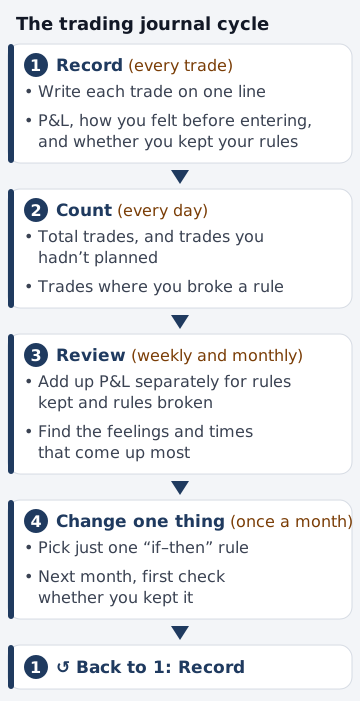
The cycle at a glance
What to record for each trade
Too many columns make a journal hard to keep up. For your first week, the three above are enough.
- How you felt before entering (one word): rushed, frustrated, bored, anxious, tired, calm, and so on. Choosing your words in advance makes them easier to count later.
- Kept my rules? (yes/no): if not, note which rule in a few words (“moved my stop”). If you are unsure, mark it no.
- P&L: copying it from your broker’s trade history is the most reliable. Use the amount after spread, commission and swap (if any; on swap-free accounts, any fee charged instead).
Four columns to add once it’s a habit
- Date and time: when you entered and when you closed.
- Symbol and direction: for example, “EUR/USD buy”.
- Planned setup? (yes/no): did the trade match the conditions (your own rules) you set before entering?
- Note: one line on why you entered, or anything you noticed.
P&L alone can’t tell apart “a loss where I followed my rules and exited at my planned stop” and “a loss where I jumped into an unplanned trade right after another loss”. Writing your feelings and rules on the same line is what lets you separate the two.
A study with 80 day traders, which tracked their emotions every day for five weeks, found that traders with stronger emotional reactions to gains and losses tended to have worse results. It does not show which one causes the other.[2] In a lab experiment (30 people), choosing a word for the emotion shown in photos of angry or fearful faces reduced the response in emotion-related brain areas. It did not study people’s own feelings during trading.[3]
Three things to check right after a trade
- Were your stop loss and take profit still where you set them before entering?
- Was your position size what you had planned?
- Before your next trade, did you look at today’s trade count and P&L?
You can sum up the answers in the “Kept my rules?” column. These checks are only examples; set your own based on your rules. For more, see What to write in a trading journal and Why you break your own trading rules.
What to count each day and each week
At the end of each day (a few minutes)
- How many trades you took today (compared with the limit you set)
- How many you hadn’t planned (“Planned setup?” was no)
- How many broke a rule (“Kept my rules?” was no)
- Today’s P&L, and your current losing streak
The daily trading tracker shows your trades, P&L and losing streak next to your own limits, with one tap after each trade. (It does not keep your feelings or rules, so write those in your journal.) If you worry about trading too often, see How to notice overtrading.
If you are taking a prop firm challenge, logging your current numbers next to your firm’s daily loss and maximum drawdown limits shows how close you are. → How prop firm loss limits are measured
Once a week
- Add up P&L separately for trades where you kept your rules and trades where you did not
- Check whether the same feeling keeps coming up before the trades where you broke a rule
- Check whether rule breaks cluster at certain times or on certain days
A review of 138 experiments (about 20,000 people) found that people who were prompted to record and check their progress toward a goal were more likely to reach it. The effect was larger when progress was recorded or reported to others. The goals were in areas like health and exercise, not trading.[1]
Once it’s a habit: a monthly review
After a few weeks, set aside about 30 minutes once a month and write down these numbers:
- Number of trades and win rate (winning trades ÷ all trades)
- Average win and average loss
- Total P&L, after spread, commission and swap (if any; on swap-free accounts, any fee charged instead). See Count your trading costs for a month.
- How often you kept your rules (“yes” answers ÷ all trades)
- Your biggest drawdown and your longest losing streak
With your win rate and your average win and loss, you can work out your average result per trade:
Average per trade = win rate × average win − loss rate × average loss
Pick a review day when you are not trading, and avoid reviewing right after a big loss, when it is harder to look at the numbers calmly. The full steps are in How to review a month of trading. To see how common a losing streak of a given length is, read Losing streaks, in numbers.
With few trades, don’t jump to conclusions
With only a few trades, results can swing a lot by chance. For example, even if your true win rate is 50% and each trade is independent, the chance that your win rate looks like 40% or less, or 60% or more, is about 75% over 10 trades, 50% over 20, 20% over 50, and 6% over 100 (a calculation example). People tend to expect small samples to look like the long-run average.[5] In a month with few trades, focus on how often you kept your rules and on your one-line notes, rather than on your win rate.
Change just one thing next month
A review may show you several things you want to fix. Still, change just one next month. If you change several things at once, you can’t tell which one made a difference.
Write the change as an “if–then” rule. A meta-analysis of many studies reported that linking a situation to an action in advance (implementation intentions) helped people reach their goals.[4] For example: “If I just closed a losing trade → no new trades for the time I set.” This is an example, not a recommendation. Choose your own rule and numbers. In next month’s review, start by checking whether you kept that one rule.
Once it’s a habit: using your MT4/MT5 history
For P&L, times and size, copying from your MT4/MT5 history is more reliable than writing them by hand.
- MT5: use the “History” tab. To see one trade per row, the Positions view is easiest, and you can choose a period.[6] The report can be saved as HTML or PDF.[7]
- MT4: right-click the “Account History” tab to choose a period, then use “Save as Report” to save it as an HTML file.[8]
- Turn it into numbers: copy the profit column and paste it into the trading stats calculator to get win rate, average win and loss, profit factor, max drawdown and the longest losing streak. Deposit and withdrawal rows are skipped, and everything is calculated on your device.
- Times: MT4/MT5 show times in your broker’s server time, which may differ from your local time. Converting them with the MT4/MT5 server time converter lets you see patterns like “more rule breaks late at night” correctly.
Your history shows what happened: prices, size, P&L. Why you entered, how you felt and whether you kept your rules are not in it, so add them in your journal. Menu names can differ slightly by version and language setting. The full steps are in How to export and review your MT4/MT5 trade history.
Mobile MT4/MT5 apps, other platforms and your broker’s own screens usually show your trade history too, though the steps differ. If you can’t export it, copying the time and P&L by hand, one line per trade, is enough.
Why journals stop, and what helps
- Too much to write: keep it to three things (how you felt, whether you kept your rules, P&L). Add more once it becomes a habit.
- It feels like a chore, so you put it off: write one line as soon as the trade closes. If writing by hand is hard for you, a spreadsheet, a notes app or voice typing works just as well.
- You use different words for your feelings every time, so you can’t count them: choose about five to eight words in advance and pick from those (the number is just an example).
- You don’t want to look at your records after a losing day: set your review day for a day when you are not trading. Even a single line is enough to count later.
- Reviewing doesn’t show you anything: don’t stop at the total. Add up results separately for rules kept and rules broken.
- Too many things to fix: change only one thing next month.
If there is a rule you keep breaking, Why you break your own trading rules looks at why that happens, and the trading psychology guide covers thinking traps you can spot in your records.
About this page
The studies on this page looked at health and exercise goals, a small group of day traders, and lab experiments, not at forex journals themselves. Many were also done with people in a few countries, so the effects may differ in other places and cultures. A journal will not necessarily improve your results. Which columns help differs from person to person, so feel free to adapt the format until it is easy to keep up. If losses are causing you distress, or you find it hard to stop even when you want to, please don’t carry it alone: talk to someone close to you or a support service where you live.
Sources
- Harkin, B., Webb, T. L., Chang, B. P. I., Prestwich, A., Conner, M., Kellar, I., Benn, Y., & Sheeran, P. (2016). Does monitoring goal progress promote goal attainment? A meta-analysis of the experimental evidence. Psychological Bulletin, 142(2), 198–229. https://doi.org/10.1037/bul0000025
- Lo, A. W., Repin, D. V., & Steenbarger, B. N. (2005). Fear and Greed in Financial Markets: A Clinical Study of Day-Traders. American Economic Review, 95(2), 352–359. https://doi.org/10.1257/000282805774670095
- Lieberman, M. D., Eisenberger, N. I., Crockett, M. J., Tom, S. M., Pfeifer, J. H., & Way, B. M. (2007). Putting feelings into words: Affect labeling disrupts amygdala activity in response to affective stimuli. Psychological Science, 18(5), 421–428. https://doi.org/10.1111/j.1467-9280.2007.01916.x
- Gollwitzer, P. M., & Sheeran, P. (2006). Implementation Intentions and Goal Achievement: A Meta-analysis of Effects and Processes. Advances in Experimental Social Psychology, 38, 69–119. https://doi.org/10.1016/S0065-2601(06)38002-1
- Tversky, A., & Kahneman, D. (1971). Belief in the law of small numbers. Psychological Bulletin, 76(2), 105–110. https://doi.org/10.1037/h0031322
- MetaQuotes. Executing Trades (Trading history) — MetaTrader 5 Help. https://www.metatrader5.com/en/terminal/help/trading/performing_deals
- MetaQuotes. Trading Report — MetaTrader 5 Help. https://www.metatrader5.com/en/terminal/help/trading/report
- MetaQuotes. Account History — MetaTrader 4 Help. https://www.metatrader4.com/en/trading-platform/help/overview/terminal/terminal_account_history