Year-end holidays 2026-27 (list of dates)
The table lists the holidays published by governments, exchanges and central banks, from US Thanksgiving to January 4. Blank cells are normal weekdays. Stock exchange and payment-system holidays are set separately from your forex broker's hours: a closed exchange does not by itself mean forex trading stops.
Scroll the table sideways →
| Date | US | UK | Australia (NSW) | Japan (Tokyo Stock Exchange) | Euro payments (T2) |
|---|---|---|---|---|---|
| Thu Nov 26 | Thanksgiving Day[2] | ||||
| Fri Dec 25 | Christmas Day[2] | Christmas Day[3] | Christmas Day[4] | Open as usual | Closed[6] |
| Sat Dec 26 | Boxing Day[4] | (Saturday) | |||
| Mon Dec 28 | Boxing Day (substitute day)[3] | Additional day (Boxing Day)[4] | |||
| Wed Dec 30 | Last business day of 2026[5] | ||||
| Thu Dec 31 | Closed[5] | ||||
| Fri Jan 1 | New Year's Day[2] | New Year's Day[3] | New Year's Day[4] | Closed[5] | Closed[6] |
| Sat Jan 2, Sun Jan 3 | Closed[5] | ||||
| Mon Jan 4 | First business day of 2027[5] |
- US: the holidays observed by the Federal Reserve System, the US central bank.[2] The next US holiday after New Year's Day is Martin Luther King Jr. Day, Monday, January 18, 2027.[2]
- UK: bank holidays in England and Wales. Boxing Day (December 26) falls on a Saturday, so the bank holiday moves to Monday, December 28.[3] Scotland and Northern Ireland can have different dates.
- Australia: public holidays in New South Wales, the state that includes Sydney. Boxing Day falls on a Saturday, so Monday, December 28 is an additional public holiday.[4] Holidays differ between states.
- Japan: the closing days of Japan Exchange Group, which runs the Tokyo Stock Exchange (in Japanese).[5] The "last" and "first business day" entries are counted from that list.
- New Zealand (not in the table): Boxing Day is observed on Monday, December 28, and the day after New Year's Day on Monday, January 4.[10] If you trade from another country, such as Canada, India, Singapore or South Africa, check your own government's holiday list as well.
- Euro payments (T2): the system run by the European Central Bank and other central banks to settle payments in euros. For euro settlement it is closed on days including New Year's Day, December 25 and December 26.[6]
These are days when a country's payment system or exchange closes. Whether your forex broker stops trading on those days is a separate question. See how to check your broker's hours below.
When each holiday starts and ends in ET, London and Tokyo time
A holiday runs from 00:00 to 24:00 on the local clock. On other clocks it looks like this. US daylight saving time ended on November 1, so New York (ET) is 5 hours behind London and 14 hours behind Tokyo in this period (our own calculation; see daylight saving and forex hours for the clock changes). To read any of these times on your own clock, you can use the forex market hours tool to see the time difference (it does not include holidays). For example, the UK Christmas holiday begins at 19:00 on December 24 in New York.
Scroll the table sideways →
| Holiday (local date) | New York (ET) | London | Tokyo |
|---|---|---|---|
| US Thanksgiving, Nov 26 | Thu Nov 26, all day | Thu Nov 26 05:00 – Fri Nov 27 05:00 | Thu Nov 26 14:00 – Fri Nov 27 14:00 |
| NSW Christmas and Boxing Day, Dec 25–26 | Thu Dec 24 08:00 – Sat Dec 26 08:00 | Thu Dec 24 13:00 – Sat Dec 26 13:00 | Thu Dec 24 22:00 – Sat Dec 26 22:00 |
| UK Christmas Day, Dec 25 | Thu Dec 24 19:00 – Fri Dec 25 19:00 | Fri Dec 25, all day | Fri Dec 25 09:00 – Sat Dec 26 09:00 |
| US Christmas Day, Dec 25 | Fri Dec 25, all day | Fri Dec 25 05:00 – Sat Dec 26 05:00 | Fri Dec 25 14:00 – Sat Dec 26 14:00 |
| NSW additional day, Dec 28 | Sun Dec 27 08:00 – Mon Dec 28 08:00 | Sun Dec 27 13:00 – Mon Dec 28 13:00 | Sun Dec 27 22:00 – Mon Dec 28 22:00 |
| UK substitute day, Dec 28 | Sun Dec 27 19:00 – Mon Dec 28 19:00 | Mon Dec 28, all day | Mon Dec 28 09:00 – Tue Dec 29 09:00 |
| Tokyo Stock Exchange closed, Dec 31 – Jan 3 | Wed Dec 30 10:00 – Sun Jan 3 10:00 | Wed Dec 30 15:00 – Sun Jan 3 15:00 | Thu Dec 31 00:00 – Mon Jan 4 00:00 |
| NSW New Year's Day, Jan 1 | Thu Dec 31 08:00 – Fri Jan 1 08:00 | Thu Dec 31 13:00 – Fri Jan 1 13:00 | Thu Dec 31 22:00 – Fri Jan 1 22:00 |
| UK New Year's Day, Jan 1 | Thu Dec 31 19:00 – Fri Jan 1 19:00 | Fri Jan 1, all day | Fri Jan 1 09:00 – Sat Jan 2 09:00 |
| US New Year's Day, Jan 1 | Fri Jan 1, all day | Fri Jan 1 05:00 – Sat Jan 2 05:00 | Fri Jan 1 14:00 – Sat Jan 2 14:00 |
As a guide to the normal trading week, the Australian Foreign Exchange Committee says normal trading "commences from 5.00 am (Sydney time) on Monday and closes at 5.00 pm (New York time) on Friday".[9] In December, that is 13:00 Sunday to 17:00 Friday in ET, 18:00 Sunday to 22:00 Friday in London, and 03:00 Monday to 07:00 Saturday in Tokyo (our own calculation). Your broker may open and close at different times.
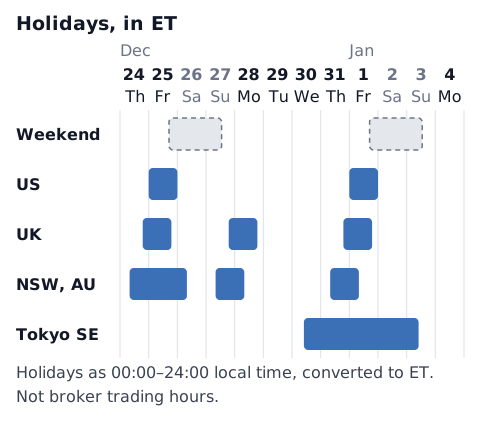
What the chart shows:
- Thursday evening in New York is already a holiday elsewhere: on December 24 and December 31, the UK holiday starts at 19:00 ET, and New South Wales is on holiday from 08:00 ET that morning.
- The Friday holidays cover the end of the trading week: on December 25 and January 1, both London and New York are on holiday until the week closes at 17:00 ET.
- Monday, December 28 opens with the UK and Australia on holiday: the US and Japan have a normal weekday.
- The Tokyo closure overlaps normal weekdays elsewhere: in ET it starts at 10:00 on Wednesday, December 30, and trading continues in other centers.
What can happen around the holidays
When fewer people are trading, the spread (the gap between the buy and sell prices) can widen, prices can jump more, and orders may not fill at the price you expected. In Japan, for example, the Financial Futures Association of Japan says to take particular care on major countries' holidays, such as Christmas, and in the early-morning hours, when less is traded, because spreads can widen (in Japanese).[8] The same association notes that on New Year's Day and Christmas, the hours outside the Tokyo session are not part of the "almost 24 hours" (in Japanese).[7]
See what is the spread and price gaps and your stop-loss for more. What can happen when you hold over a weekend or holiday (gaps, swap by weekday) is covered in forex market holidays and holding over the weekend.
How to check your broker's hours
- Look at your broker's announcements in mid-December: CME says its holiday schedules are subject to change and that "Trading hours are usually finalized approximately two weeks prior to the holiday".[1] As of October 2026, its 2026 Globex schedule lists holiday schedules for Christmas (December 24–26) and New Year's (December 31 to January 1).[1] Your broker's year-end hours may not be set yet either, so check again in mid-December.
- Read what kind of "holiday" it is: an announcement may separate times when you cannot trade, times when trading closes early, how swap is charged, and when deposits and withdrawals are not processed. It can also differ by symbol (currency pairs, gold and so on).
- Check which clock the times use: your local time, your broker's MT4/MT5 server time, or New York time. To convert server time to your own, use the server time converter.
- Look at the symbol specification in MT5: choosing "Specification" from the right-click menu of the Market Watch window shows the trading sessions for each weekday. The steps are in how to check your broker's trading hours. Whether special holiday hours appear there depends on the broker.
- Review orders and anything that runs on a clock: check how your time-based rules, EAs (programs that trade automatically in MT4/MT5) and alerts handle the holiday hours.
The forex market hours tool shows the usual hours of each center on your own clock. It does not include holidays, so over the year-end, use it together with the tables here and your broker's announcements.
What to note in your records (you decide)
This article does not decide whether you trade, take a break or hold positions over the holidays. If you keep records, you can see later how it went for you.
- Whether the position was held over the holidays, and from which day to which day
- How spreads and fill prices around the holidays compared with a normal week
- The swap charged or paid in that time, if your account has swap (the Swap column in your history)
- How you felt trading over the holidays, and whether your times or position sizes were different from usual
To total up swap over a number of nights, use the swap calculator.
Sources
- CME Group. CME Group Holiday and Trading Hours (2026 CME Globex Trading Schedule). https://www.cmegroup.com/trading-hours.html
- Board of Governors of the Federal Reserve System. Holidays Observed by the Federal Reserve System. https://www.federalreserve.gov/aboutthefed/k8.htm
- GOV.UK. UK bank holidays (England and Wales). https://www.gov.uk/bank-holidays
- NSW Government. NSW public holidays. https://www.nsw.gov.au/about-nsw/public-holidays
- Japan Exchange Group. 営業時間・休業日一覧 (Business hours and holidays) [in Japanese]. https://www.jpx.co.jp/corporate/about-jpx/calendar/index.html
- European Central Bank. T2. https://www.ecb.europa.eu/paym/target/t2/html/index.en.html
- The Financial Futures Association of Japan. 学ぼう!FX #6 取引時間について (Learn FX #6: About trading hours) [in Japanese]. https://www.ffaj.or.jp/learning/?p=21
- The Financial Futures Association of Japan. 学ぼう!FX #7 スプレッド、手数料について (Learn FX #7: About spreads and fees) [in Japanese]. https://www.ffaj.or.jp/learning/?p=23
- Australian Foreign Exchange Committee. Q&A (Question 3). https://afxc.rba.gov.au/qa/
- New Zealand Government (govt.nz). Public holidays and anniversary dates. https://www.govt.nz/browse/work/public-holidays-and-work/public-holidays-and-anniversary-dates/