What the FIFO rule is
FIFO stands for first-in, first-out: what went in first comes out first.
The NFA (National Futures Association) is the industry-wide self-regulatory organization for the US derivatives industry, designated by the CFTC (Commodity Futures Trading Commission) as a registered futures association.[6] Section (b) of its Rule 2-43, "Offsetting Transactions", says:[1]
- Forex Dealer Members (FDMs) may not carry offsetting positions in a customer account, and must offset them on a first-in, first-out basis.
- At the customer's request, an FDM may offset same-size transactions even if there are older transactions of a different size, but must offset the transaction against the oldest transaction of that size.
An FDM is an NFA member that is the counterparty, or offers to be the counterparty, to forex transactions.[5]
Rule 2-43 was adopted effective May 15, 2009.[1] NFA's April 2009 notice said section (b) prohibits "a trading practice commonly referred to as 'hedging'", and that the ban on carrying offsetting positions applies to positions established after May 15, 2009.[2] A May 2009 notice then extended the effective date of the FIFO part alone to July 31, 2009, after dealers asked for more time for the programming changes.[3]
Whose accounts it covers
The rule is addressed to NFA members that act as forex dealers (FDMs).[1] NFA's forex regulatory guide says FDMs must be registered as either an FCM (futures commission merchant) or an RFED (retail foreign exchange dealer).[4]
The same guide defines a customer as "any party to a forex trade who is not an eligible contract participant", which "includes individuals with assets of less than $10 million and most small businesses".[4] In other words, it covers most individual traders' accounts at US FDMs.
You can check whether a firm is an NFA member with NFA's BASIC search; see how to check a broker. Whether your account closes positions FIFO is something to check in your broker's account terms. In an MT5 account with the FIFO rule, closing in a different order returns an error (see "How MT5 handles it" below).[7]
Other US rules, such as the leverage limits, are covered in forex leverage limits by country and region.
Closing order: oldest position first
Say you buy 0.1 lot of EUR/USD three times, at 1.0800, 1.0850 and 1.0900. If you then sell 0.1 lot in a FIFO account, the buy opened first, at 1.0800, is closed. The buys at 1.0850 and 1.0900 stay open.
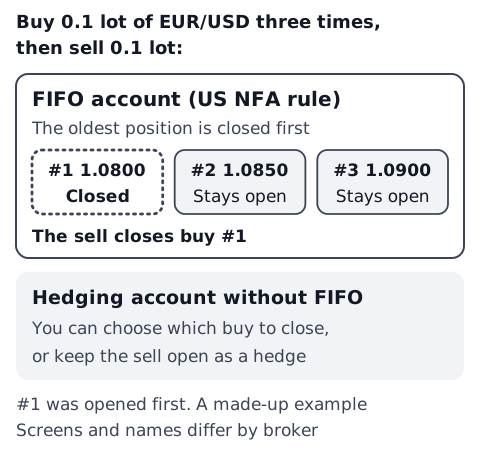
Some accounts without a FIFO rule let you choose which position to close, or hold the sell as a separate position (a hedge). Hedging and the netting and hedging account types are explained in what is hedging in forex.
How MT5 handles it
The MT5 help says that, to meet the requirements of authorities such as the NFA, a broker can set a closing rule on an account that allows only FIFO closing.[7]
- Positions for each instrument can only be closed in the order they were opened. If you try a different order, the platform returns an error.[7]
- The rule can only be enabled for hedging accounts.[7]
- If a Stop Loss or Take Profit triggers on a position that does not comply with FIFO, that position is not closed. To prevent this, when there are several positions on the same instrument, placing stop levels on any one of them places the same levels on all the others.[7]
So in such an MT5 account, stop levels on the same instrument are kept the same across all positions. MT4, mobile apps and other platforms may work differently, so check your broker's documentation too. For the full list of order types, see forex order types.
The exception: offsetting same-size transactions
Under Rule 2-43(b), at the customer's request, a dealer may offset same-size transactions even if there are older transactions of a different size. Even then, it must use the oldest transaction of that size.[1]
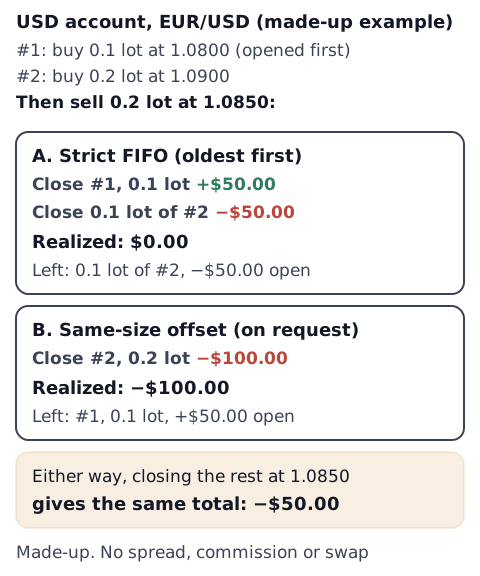
The chart below shows two buys of different sizes, followed by a 0.2 lot sell. A matches the sell to the oldest positions first. B asks the dealer to offset against the same-size (0.2 lot) transaction.
Worked example
A USD account buys #1, 0.1 lot (10,000 units) of EUR/USD at 1.0800, then #2, 0.2 lot (20,000 units) at 1.0900. With the price at 1.0850, it sells 0.2 lot.
A. Oldest first
#1: (1.0850 − 1.0800) × 10,000 = +$50.00
0.1 lot of #2: (1.0850 − 1.0900) × 10,000 = −$50.00
Realized: $0.00
Left open: 0.1 lot of #2 (−$50.00)
B. Offset against the same-size (0.2 lot) transaction
#2: (1.0850 − 1.0900) × 20,000 = −$100.00
Realized: −$100.00
Left open: #1, 0.1 lot (+$50.00)
Either way, closing the rest at the same 1.0850 gives a total of −$50.00. What changes is the realized P&L at that moment, and the entry price of what is left open.
The rule text does not say how part of a larger position should be matched. A is one way to count when matching oldest first. How a dealer takes this request, and how it handles partial closes, is something to check in your broker's documentation. How to calculate profit and loss is covered in how to calculate forex profit and loss.
Counting it in your records (you decide)
In a FIFO account, the result of each close may be matched to an older position rather than the one you had in mind. When you keep records, separating these makes them easier to review later:
- Each entry on its own: when, at what price and how much, one line per position.
- Which one was closed: check your broker's deal history to see which entry each close was matched to.
- The total of the group: for entries in a row on the same pair, also look at the total once everything is closed.
- Costs on top: swap and commission depend on how long you held and how many trades you made. See what is swap and what is a lot.
Result of the group = realized P&L + open P&L of what is left + swap + commission
This article does not decide whether you should use a FIFO account or how to trade. The pip value calculator turns pips into money, and the swap calculator estimates swap.
Sources
- National Futures Association. Rule 2-43. Forex Orders (NFA Rulebook, checked October 17, 2026). https://www.nfa.futures.org/rulebook/rules.aspx?RuleID=RULE%202-43&Section=4
- National Futures Association. Notice I-09-10: Effective Date of NFA Requirements Regarding Forex Orders (April 13, 2009). https://www.nfa.futures.org/newsnotices/newsArticle.aspx?ArticleID=2273
- National Futures Association. Notice I-09-12: Revised Effective Date for Portions of NFA Compliance Rule 2-43(b) (May 5, 2009). https://www.nfa.futures.org/newsnotices/newsArticle.aspx?ArticleID=2281
- National Futures Association. Forex Transactions: Regulatory Guide. https://www.nfa.futures.org/members/member-resources/files/forex-regulatory-guide.html
- National Futures Association. Bylaw 306. Forex Dealer Members (NFA Rulebook). https://www.nfa.futures.org/rulebook/rules.aspx?RuleID=BYLAW%20306&Section=3
- National Futures Association. About NFA. https://www.nfa.futures.org/about/index.html
- MetaQuotes. Executing Trades: Closing positions using the FIFO rule (MetaTrader 5 Help). https://www.metatrader5.com/en/terminal/help/trading/performing_deals