What loss aversion is
The paper that set out prospect theory describes loss aversion as losses looming larger than gains, and says the pain of losing a sum of money appears to be greater than the pleasure of gaining the same amount.[1] The same paper notes that most people find a fifty-fifty bet, win x or lose x, distinctly unattractive.[1]
How much heavier?
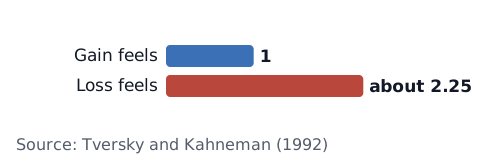
In a later study by the same authors, 25 US graduate students with no special training in decision theory took part in an experiment. At the median, losses were felt about 2.25 times as heavily as gains of the same size, which the paper describes as pronounced loss aversion.[2]
A paper from the UK Financial Conduct Authority (FCA) also says that, psychologically, losses are felt roughly twice as much as gains of the same size.[3] Note that 2.25 is the median of a 25-person experiment and varies by person and situation. It does not mean everyone feels losses exactly 2.25 times as much.
A survey in 53 countries found that the strength of loss aversion differs by culture.[5] And one paper argues that current evidence does not show losses to be, on balance, more impactful than gains.[6]
In trading, it is often linked to taking profits too early
A study of 10,000 individual accounts at a US discount broker (1987 to 1993, stocks) found that a stock trading above its purchase price (a paper gain) was sold at about 1.5 times the rate of one trading below it (a paper loss).[4] The study says this way of selling was not justified by how the portfolios performed afterwards.[4] This pattern is called the disposition effect; prospect theory, including loss aversion, is one proposed explanation, not a proven cause.
In forex, it might look like this (these are our own examples):
- As soon as a trade shows a small profit, you close it before it reaches the target you planned
- You hold a losing trade, waiting for it to come back (see before you move your stop loss)
With small wins and big losses, the total can be negative even with a high win rate. For how win rate and the size of wins and losses fit together, see risk-reward ratio and break-even win rate. These are studies of stocks and experiments, and they may not carry over to forex.
Check your own records (you decide)
Loss aversion is hard to notice in the moment, so comparing your records makes it easier to see:
- Average win and average loss: which one is bigger
- Whether you waited for your planned target: how often you waited, and how often you closed early
- How you felt when you closed: note things like "closed early because I was scared"
The trading stats calculator turns a profit and loss list into your average win and loss. This article does not decide how you should trade.
Sources
- Kahneman, D., & Tversky, A. (1979). Prospect Theory: An Analysis of Decision under Risk. Econometrica, 47(2), 263–291. https://doi.org/10.2307/1914185
- Tversky, A., & Kahneman, D. (1992). Advances in Prospect Theory: Cumulative Representation of Uncertainty. Journal of Risk and Uncertainty, 5(4), 297–323. https://doi.org/10.1007/BF00122574
- Erta, K., Hunt, S., Iscenko, Z., & Brambley, W. (2013). Applying behavioural economics at the Financial Conduct Authority. FCA Occasional Paper No. 1. https://www.fca.org.uk/publication/occasional-papers/occasional-paper-1.pdf
- Odean, T. (1998). Are Investors Reluctant to Realize Their Losses? The Journal of Finance, 53(5), 1775–1798. https://doi.org/10.1111/0022-1082.00072
- Wang, M., Rieger, M. O., & Hens, T. (2017). The Impact of Culture on Loss Aversion. Journal of Behavioral Decision Making, 30(2), 270–281. https://doi.org/10.1002/bdm.1941
- Gal, D., & Rucker, D. D. (2018). The Loss of Loss Aversion: Will It Loom Larger Than Its Gain? Journal of Consumer Psychology, 28(3), 497–516. https://doi.org/10.1002/jcpy.1047