What revenge trading looks like
It is a trade you take right after a loss, skipping your usual process. Common signs:
- You increase your position size to get the loss back in one trade
- You take a setup you would normally skip (your own entry rules are not met)
- You move your stop loss further away, or don’t use one
- The time between closing one trade and opening the next suddenly gets shorter
Each of these is something you probably wouldn’t have done without the loss. The simplest test is one question: “Would I take this trade if I hadn’t just lost?”
On a prop firm account (trading the firm’s capital), some firms close your account if you hit their daily loss limit or maximum drawdown. Revenge trades can push you toward those limits fast, so they matter even more there.
Why it happens
Research has looked at how decisions change after a loss.
- Losses hurt more than gains of the same size feel good. And when a loss seems certain, people tend to choose more risk (prospect theory).[1]
- After a loss, people want a chance to get back to even. In experiments, people who had just lost were drawn to bets that could win the loss back.[2]
- Professionals do it too. A study of traders at the Chicago Board of Trade found that traders who lost in the morning tended to take above-average risk in the afternoon.[3]
These studies looked at experiments and futures traders, so the effect may not be the same size for retail forex traders. But they do suggest that wanting more risk after a loss is not only a willpower problem. That is why it can help to decide in advance, instead of relying on willpower in the moment.
Five rules to set before you lose
Research on goals has found that if-then plans, such as “if X happens, I will do Y”, help people follow through.[4] That research was not about trading, so results will vary. None of the five rules below is new. The difference is writing them down before you lose. Everyone’s numbers are different, so use the examples for the format and fill in your own values.
1. Turn your daily loss limit into a money amount
“If today’s loss reaches X, I stop trading for the day.” Turning a percentage limit into a money amount can make it easier to act on in the moment. The daily loss limit calculator turns your balance and percentages into daily, weekly and monthly amounts.
On a prop firm account, you can set your own limit below the firm’s daily limit, so you stop at your line before you reach theirs. Firms differ in when the trading day resets and what counts toward the loss, so check your own firm’s rules.
2. Set a losing-streak limit, and what you do next
“If I lose X trades in a row, I step away for 30 minutes.” “If I lose X in a row, I’m done for the day.” Pair the number with an action. Even with a decent win rate, losing streaks will happen if you trade often enough. The losing streak calculator shows how long a streak is likely at your win rate, so it is less of a shock when it comes.
3. Don’t increase your size after a loss
“If I just lost, my next trade is the same size or smaller.” You can work out your size in advance from how much you are willing to lose on one trade and your stop distance (position size calculator). The point is not to decide it right after a loss.
4. Ask one question before your next trade
“Would I take this trade if I hadn’t just lost?” If the answer is no, or you are not sure, skip it. Some traders put this question on a note next to their screen.
5. Decide how and when you stop
“If I hit my limit, I confirm my positions are closed, close the trading platform, write up the day, and stop.” Deciding the steps in order makes “just one more trade” harder. If you trade before work or in a break, a time rule also helps: “X minutes before I leave, I don’t open new trades.”
- If today’s loss reaches X → I stop for the day and close the platform
- If I lose X in a row → I take an X-minute break
- If I just lost → same size or smaller
- If the answer to “Would I take this without the last loss?” is no → I skip it
- If it is X minutes before I leave → no new trades
What “winning it back” takes, in numbers
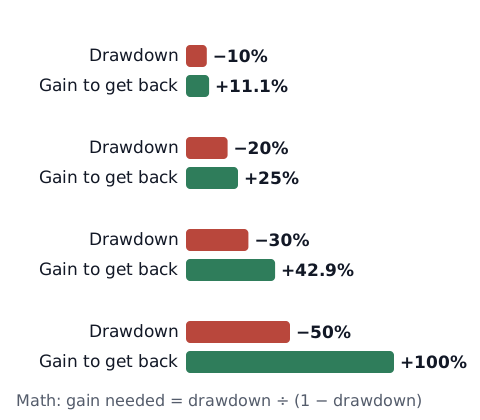
After a drawdown, getting back to your starting balance takes a bigger percentage gain than the percentage you lost: −10% needs +11.1%, −20% needs +25%, and −50% needs +100%. You can check this with the drawdown recovery calculator. The deeper the drawdown, the faster the gain you need grows. That is why a limit that stops you early on a bad day matters.
Keep a record and learn your pattern
Revenge trades are hard to notice while they are happening. Log just three things for each trade, so you can look back later:
- How you felt when you entered (rushed, wanting to win it back, calm, and so on)
- Whether you kept your rules (yes / no)
- Whether the previous trade was a loss
After a week or two, compare the trades where you kept your rules with the trades where you didn’t: the P&L, and how often each happened. You will start to see when you tend to slip.
Sources
- Kahneman, D., & Tversky, A. (1979). Prospect Theory: An Analysis of Decision under Risk. Econometrica, 47(2), 263–291. https://doi.org/10.2307/1914185
- Thaler, R. H., & Johnson, E. J. (1990). Gambling with the House Money and Trying to Break Even: The Effects of Prior Outcomes on Risky Choice. Management Science, 36(6), 643–660. https://doi.org/10.1287/mnsc.36.6.643
- Coval, J. D., & Shumway, T. (2005). Do Behavioral Biases Affect Prices? The Journal of Finance, 60(1), 1–34. https://doi.org/10.1111/j.1540-6261.2005.00723.x
- Gollwitzer, P. M. (1999). Implementation intentions: Strong effects of simple plans. American Psychologist, 54(7), 493–503. https://doi.org/10.1037/0003-066X.54.7.493