What the gambler's fallacy is
A 1971 paper describes it this way: people act as if every part of a random sequence must reflect the true proportion, so when the sequence strays one way, they expect a correction the other way. This is called the gambler's fallacy.[1]
Using the example of a coin, the same paper explains that a run one way is not soon canceled by a run the other way; as more tosses are made, it is only diluted.[1] For example, if a fair coin lands heads five times in a row, the chance of tails on the sixth toss does not change (our own example).
A study of real roulette bets
One study looked at the records of 24,131 bets placed by 139 roulette players over 18 hours in a US casino.[2]
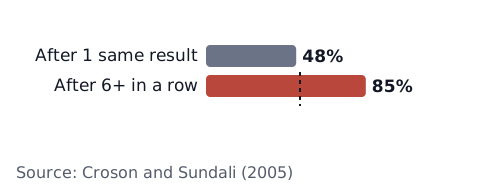
- After one spin: of 531 even-money bets such as red or black, 255 (48%) were against the previous outcome, showing almost no bias[2]
- As runs got longer: there were no clear differences after runs of one to four. After runs of five, and of six or more, betting against the run showed up clearly[2]
- After runs of 6 or more: 85% of bets were placed against the run[2]
This is 18 hours of records from one casino, not a study of trading.
Outside gambling too
A study of refugee asylum judges, loan application reviews and baseball umpires found that after making the same decision several times in a row, decision makers leaned toward the opposite decision. The authors say this is most consistent with the gambler's fallacy: people underestimating how often streaks happen by chance, though they could not fully rule out one other explanation.[3]
Where it can show up in trading
For example (these are our own examples):
- After a losing streak, you feel a win is due and increase your lot size
- After several candles in the same direction, you enter only because "it must turn soon"
Trade results are not necessarily independent like roulette spins. But the feeling that "it kept going one way, so the next one goes the other way" does not tell you the next result. For how likely losing streaks are at a given win rate, see losing streaks, in probabilities, and for rules to set before you want to win it back, see how to stop revenge trading.
Check your own records (you decide)
- Lot size after a losing streak: is it bigger than usual?
- How you felt after a losing streak: results of trades you took because a win felt due, or you wanted to win it back
- Length of your streaks: how long your losing streaks have been in your own records
The losing streak calculator shows how likely streaks are, and the trading stats calculator shows the longest losing streak in your records. This article does not decide how you should trade.
If the urge to win it back keeps coming and you find it hard to stop, you can talk to a gambling or addiction support service where you live.
Sources
- Tversky, A., & Kahneman, D. (1971). Belief in the law of small numbers. Psychological Bulletin, 76(2), 105–110. https://doi.org/10.1037/h0031322
- Croson, R., & Sundali, J. (2005). The Gambler's Fallacy and the Hot Hand: Empirical Data from Casinos. Journal of Risk and Uncertainty, 30(3), 195–209. https://doi.org/10.1007/s11166-005-1153-2
- Chen, D. L., Moskowitz, T. J., & Shue, K. (2016). Decision Making Under the Gambler's Fallacy: Evidence from Asylum Judges, Loan Officers, and Baseball Umpires. The Quarterly Journal of Economics, 131(3), 1181–1242. https://doi.org/10.1093/qje/qjw017