What confirmation bias is
A review of psychology research describes confirmation bias as seeking or interpreting evidence in ways that lean toward existing beliefs, expectations, or a hypothesis in hand.[1] It usually refers to choosing which evidence to collect and use without realizing it.[1]
The same review also describes gathering, or giving too much weight to, evidence that supports your position, while not gathering, or playing down, evidence against it.[1]
An investor education page from the Ontario Securities Commission in Canada describes confirmation bias as the tendency to search for, favor, or interpret information that confirms your existing beliefs, and calls it one of the most deeply ingrained behavioral biases.[3]
A study of investors on stock message boards
One study looked at 502 investor responses from an experiment run with one of the largest stock message board operators in South Korea. According to the study's abstract:[2]
- Investors gave more weight to posts that supported their prior beliefs (confirmation bias)
- This was stronger for investors who felt they knew more about the market, and for those with stronger feelings about a particular stock
- Investors showing confirmation bias were also more overconfident; they traded more actively and expected higher market returns than was warranted
This is a study of stock message boards, and it may not carry over to forex. It also comes from a single message board in one country, so it may not apply in the same way to other countries or markets. The points above come only from the study's abstract. For more on overconfidence and trading activity, see overconfidence and trading too much.
Where it can show up in trading
For example (these are our own examples):
- After deciding you want to enter, you look only for posts or news that give you a reason to
- You brush off news that goes against a position you hold as "not a big deal"
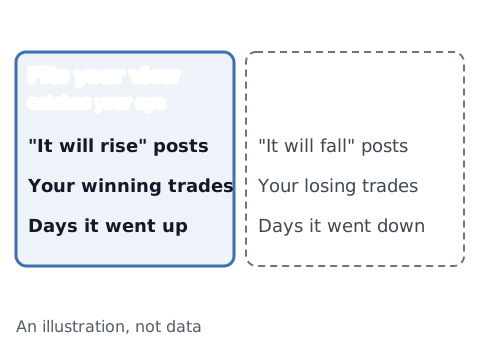
- You remember the winning trades of a strategy well, but find the losing ones harder to recall
The Ontario Securities Commission page suggests that even if you are convinced you are right, it may be wiser to stay humble.[3]
Check your own records (you decide)
Because confirmation bias is hard to notice in the moment, your records are easier to check than your memory. For example, you could log:
- One "reason it could fail" before entering: not only why you are entering, but what would prove the idea wrong (for example, "wrong if price breaks below this line" or "wrong if the data comes out weak")
- Every losing trade, per strategy: look at the losses in the same list as the wins
- Results when you felt sure: compare win rate and average profit or loss for each mood tag you create, such as "felt sure"
The trading stats calculator turns a profit and loss list into win rate and averages. This article does not decide how you should trade.
Sources
- Nickerson, R. S. (1998). Confirmation bias: A ubiquitous phenomenon in many guises. Review of General Psychology, 2(2), 175–220. https://doi.org/10.1037/1089-2680.2.2.175
- Park, J., Konana, P., Gu, B., Kumar, A., & Raghunathan, R. (2013). Information Valuation and Confirmation Bias in Virtual Communities: Evidence from Stock Message Boards. Information Systems Research, 24(4), 1050–1067. https://doi.org/10.1287/isre.2013.0492
- Ontario Securities Commission (GetSmarterAboutMoney.ca). Confirmation bias: A fundamental risk to your investing decisions. https://www.getsmarteraboutmoney.ca/learning-path/psychology-of-investing/how-confirmation-bias-poses-a-risk-to-your-investing-decisions/